
How to Choose Treats for a Dog With Allergies: Label First
This post contains affiliate links. As an Amazon Associate, we earn from qualifying purchases.
To choose treats for a dog with allergies, pick one new treat at a time, keep every treat inside a 10 percent daily calorie budget, and screen the label for the protein your dog actually reacted to. Learning how to choose treats for a dog with allergies means reading labels carefully. A single large Milk-Bone carries about 85 calories, which is more than twice the daily treat allowance for a 10 kg dog.
Eighty-five calories against a 32-calorie ceiling is the whole arithmetic problem in one biscuit. WSAVA builds that ceiling from the daily energy requirement of an average healthy adult dog at ideal body condition, so a dog carrying extra weight or built small gets even less room than the table suggests. Get the numbers straight first, and the how to choose treats for a dog with allergies decision gets a lot shorter.
What follows covers the calorie ceiling, the label screen, the treat categories that carry real risk, and the one point where two major veterinary sources flatly disagree.
Key Takeaways
- Keep treats under 10 percent of daily calories, and count every chew, training reward, and pill wrap toward that number.
- One new treat at a time, given as a small piece first. Change three things at once and you’ll never identify the culprit.
- A large Milk-Bone is about 85 calories, more than double the entire daily treat budget for a 10 kg dog.
- Skip bones, antlers, hooves, and freeze-dried raw. Bone was the foreign body in 81 percent of 222 fatal esophageal obstruction cases.
- A treat label often can’t confirm protein source. During an elimination diet, ask the vet before assuming any commercial treat is safe.
How Many Calories of Treats Can an Allergic Dog Have?
Fourteen kilocalories a day. That is the entire treat allowance WSAVA’s weight table gives a 2 kg dog.
Treats are capped at less than 10 percent of a dog’s daily calorie intake, a figure that WSAVA, FEDIAF, and VCA Animal Hospitals all publish. The remaining 90 percent or more must come from a complete and balanced food, because treats are complementary products and are not formulated to deliver full nutrition.
The three sources agree on the number. They don’t agree on the window.
VCA frames it as a per-day ceiling: 90 percent of daily calories from complete food, 10 percent from treats. WSAVA words it the same way, as less than 10 percent of daily intake. FEDIAF allows averaging instead, saying no more than 10 percent of a pet’s caloric average intake over a week or day should come from treats.
That difference matters in practice. Weekly averaging lets you spend a heavy training day and make up for it later in the week. A per-day ceiling is easier to check and harder to accidentally blow past. Pick one and stay consistent, because drifting between the two is how budgets quietly fail.
Individual treats eat the allowance fast either way. VCA puts one large Milk-Bone at about 85 calories per biscuit. For a 10 kg dog, WSAVA caps treats at 32 kcal a day, so that single biscuit is more than two days’ worth.
If you’re building a shortlist, start from dog treats for allergies that state calories per treat, then check each one against your dog’s number. WSAVA’s advice for commercial products is blunt: if the calorie figure isn’t on the label, contact the manufacturer and ask.
The biscuit is the budget.
Read the Back of the Pack Before You Trust the Front
The front of a treat bag is a menu description. The panel on the back is what’s actually on the line.
FEDIAF makes a point that most treat buyers never check: chews and treats are typically classified as complementary products, meaning they aren’t designed to be nutritionally complete. The pack has to say either “complete” or “complementary,” so read which one you’re holding before you read anything else.
That same logic runs one level up, to dog food for allergies, where the panel does far more work than the front claim. Treats deserve the same treatment.
Five things to look for on a treat label:
- A named protein source, not a category like “meat and meat derivatives.”
- A calorie figure per treat or per kilogram, so the math is possible at all.
- The word “complementary,” which tells you this is not a meal replacement.
- A company contact and a country of manufacture. If neither is printed, put it back.
- Whether sugar or a humectant such as glycerol appears in the list.
What most people get wrong: Treating “light” or “lower calorie” as a real reduction. VCA notes these labels are not significantly lower in calories than standard treats, so the budget doesn’t actually move.
A short ingredient list is not automatically a good one for the how to choose treats for a dog with allergies question. Limited-ingredient positioning tells you nothing about whether the protein in the bag matches the protein your dog reacts to.
Which Treat Types Carry Real Risk?
Three categories do most of the damage: raw and freeze-dried animal products, hard chews, and anything off your own plate.
| Treat type | Main risk | Safer swap |
|---|---|---|
| Freeze-dried or dehydrated raw | Bacteria spread through saliva and feces | A baked treat using the same protein |
| Bones, cooked or raw | Obstruction and severe internal damage | Skip entirely |
| Antlers, hooves, hard nylon | Tooth fracture that often goes unnoticed | Something that bends under a thumbnail |
| Table scraps and deli meat | Fat, salt, and hidden onion or garlic | A measured portion of the complete diet |
| Standard biscuit | Calories plus unlisted protein sources | A treat with a stated calorie count |
Worth knowing before you start: VCA and WSAVA both warn that freeze-dried and dehydrated raw treats carry a bacterial contamination risk that spreads through saliva and feces to the dog, to other pets, and to the people in the house. The risk applies even when the product is marketed as a premium single-protein option.
Commercial Biscuits and Dental Chews
Dental chews are treats first and toothbrushes second. VCA advises choosing low-calorie treats and checking the package label, so a dental chew belongs in the calorie budget like any other treat.
If you want a wider set of options that don’t lean on a single suspect protein, the hypoallergenic dog treats list is the place to compare panels side by side.
Freeze-Dried, Raw, and “Novel Protein” Claims
A novel protein in a new format is not automatically a safe protein. The dermatology literature notes that processing itself changes allergenicity, so a duck treat from a new manufacturer can still provoke a dog that reacted to duck in kibble form.
If chicken is the suspect, be strict about it. Chicken-free treats are only useful if the panel confirms it, not if the front of the bag implies it.
The Elimination Diet Rule Where Two Sources Disagree
Ask two veterinary sources whether a commercial treat can stay in a diet trial and you get opposite answers.
Where this goes sideways: Assuming the treat bag is compatible because the protein sounds unfamiliar. WSAVA’s position is that conventional treats may not be appropriate at all for a dog with dietary sensitivities or on a veterinary-prescribed diet, and the veterinary team should be asked directly.
VCA’s position is that if a dog is on a special diet, stick to treats the veterinarian deems safe to be used with that food, and ask whether a paired canned option can be baked into small treats. Under that reading, a matched treat is permissible.
WSAVA’s position is that conventional treats may not be appropriate at all for a dog with dietary sensitivities or on a veterinary-prescribed diet, because category-level ingredient listing means the label cannot confirm the protein source inside the bag.
WSAVA lands closer to the cautious side, and VCA’s practical version is to use only treats the veterinarian deems safe with that food. VCA also suggests asking the team whether a canned option that pairs with the diet can be baked into small treats, which sidesteps the label problem entirely.
The peer-reviewed diet trial methodology sets out how a trial should be structured, and it’s worth reading before you start one rather than after.
What counts as a treat during a trial is broader than most owners assume. WSAVA defines treats as snacks, chews, supplements, and foods used to administer medication, whether commercial or home prepared. Every one of those lands in the same budget and the same risk pile.
The timeline is longer than people expect. A JAVMA review of canine food allergy reports that 85 percent of dogs improve by 5 weeks of a diet trial, and extending to 8 weeks is adequate for over 95 percent of dogs. Adding anti-inflammatory treatment in the early phase can shorten a trial to 4 to 6 weeks.
Relapse timing is the part that catches owners out. In one prospective study of 46 dogs, median time to relapse after a dietary challenge was 12 hours, with a range of 1.5 hours to 10 days. A retrospective review of publications from 1990 to 2019 found only 9 percent of dogs flared within 24 hours, with half flaring by 5 days and 90 percent by 14 days.
Two different pictures, same disease. A reaction at hour six and a reaction on day nine are both consistent with food allergy.
How Do You Introduce a New Treat Without Guessing?
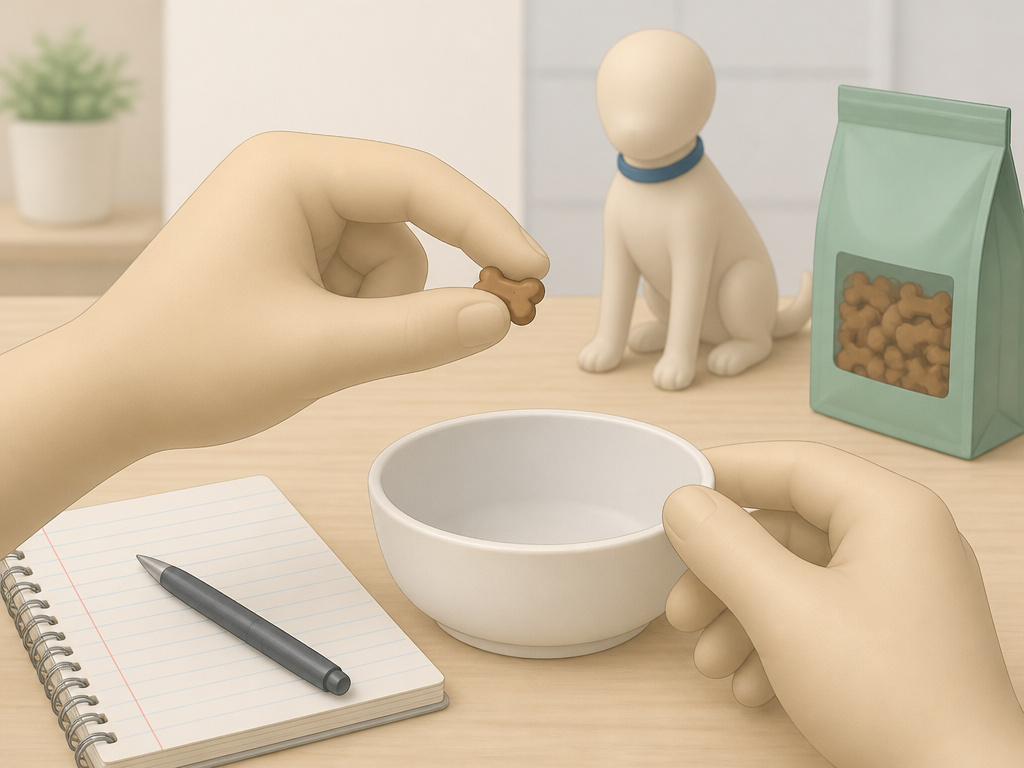
Your dog has been fine for a while. Then the scratching starts again, and you’re holding an empty bag trying to remember what changed.
Before you start: Changing the treat and the main food in the same fortnight tells you nothing about which one caused the flare. A dog on a veterinary diet may lose the therapeutic benefit of that diet once extra items go in, and a dog with a pancreatitis history needs the fat content checked before anything new goes in the bowl.
- Write down the current food and treat list first. Without a baseline, a flare two weeks later is unattributable.
- Pick one new item with a named protein your dog hasn’t eaten. Two new items at once and the reaction tells you nothing useful.
- Start with a piece the size of your thumbnail. VCA’s advice is a small piece first, especially for dogs prone to stomach upset.
- Hold everything else steady. Half of trial dogs flare within 5 days and 90 percent within 14, so that window catches most reactions.
- Log the date you started. A written date turns a vague suspicion into something your vet can actually work with.
| What you see | What it usually means | What to do |
|---|---|---|
| Itching within hours of a new treat | Fast reaction to that specific item | Stop the treat, note the date, call the vet |
| Soft stool for a day or two | Gut upset from a sudden change | Drop back to the old treat, retry smaller later |
| Scratching building over 5 to 14 days | Slower reaction, harder to spot | Review the log against the start date |
| No change at all after two weeks | That item is probably fine | Keep it and move to the next single item |
The introduce new treats sequence matters more than the specific treat you pick. If your dog has a history of loose stool on top of the allergy, the treats for sensitive stomachs comparison is a better starting point than a general list.
I ask about treats before I ask about the main diet now. One suspected sensitivity case I worked through turned out to have nothing to do with the limited formula at all. Portion size and how often treats were going in was the whole story, and the restricted diet was never necessary.
Fair enough, but look at the order. Treats first, formula second.
What Should Never Go in the Treat Bowl?
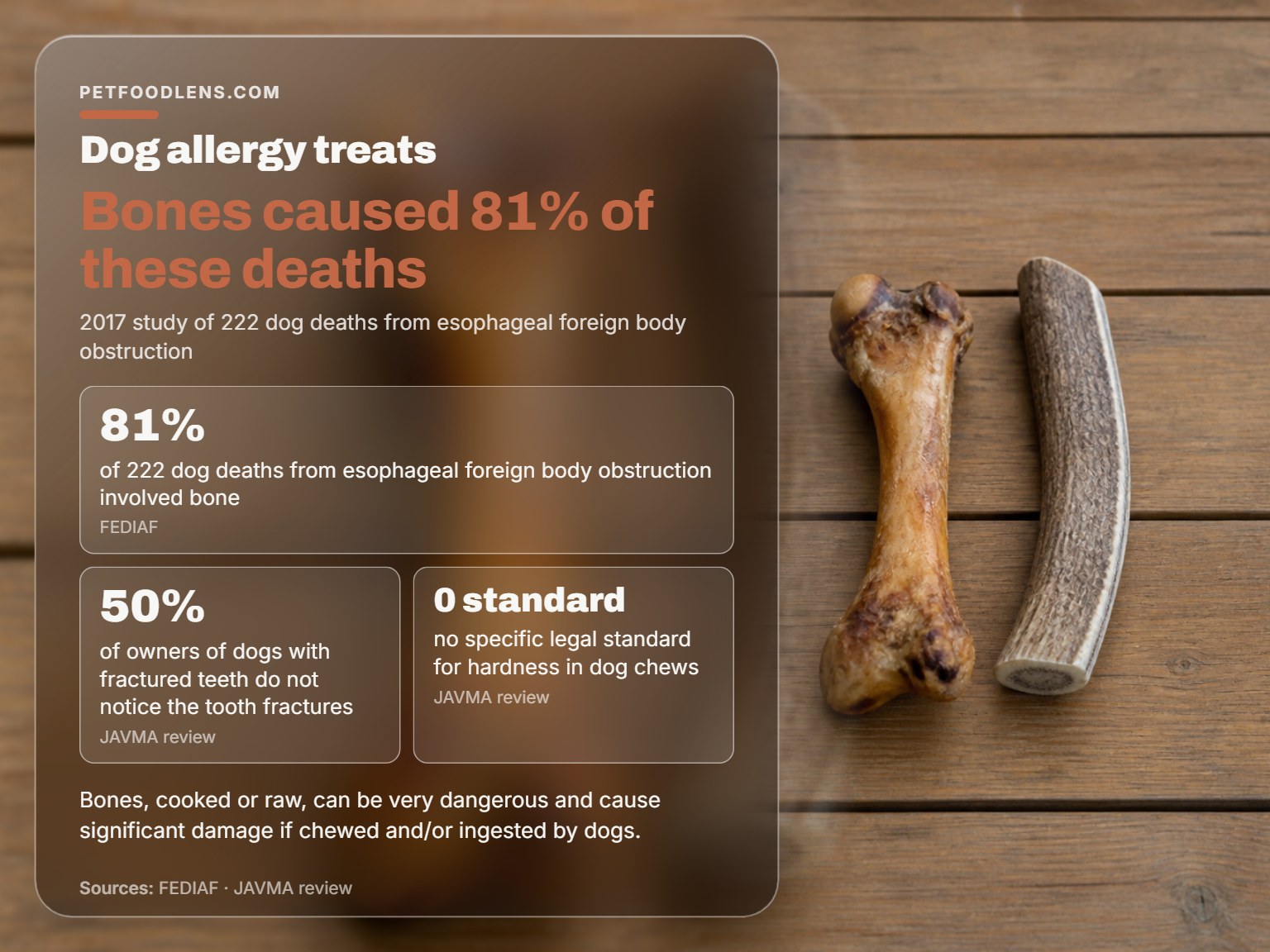
Bones do not belong in a dog’s mouth. Not cooked, not raw, not as a treat.
The numbers behind that are stark. A 2017 retrospective study of 222 dog deaths from esophageal foreign body obstruction found bone material was the foreign body in 81 percent of cases, per FEDIAF.
WSAVA’s toxin list is worth memorizing outright:
- Chocolate, and any caffeinated drink including coffee, tea, and energy drinks
- Macadamia nuts
- Onions, leeks, shallots, garlic, and chives
- Grapes, raisins, currants, and sultanas
- Xylitol, the sweetener
- Alcohol and raw yeast dough
FEDIAF adds a broader warning about human scraps in general, which tend to run high in fat, salt, sugar, and energy, or to contain something toxic by accident.
That last point is where I see the most damage. Leftover human food can carry hidden onion or garlic, and the owner handing it over thinks they’re being generous. Grapes and raisins get tossed as a healthy snack more often than they should, and because they are on WSAVA’s toxin list, skipping them beats gambling on a small amount.
Hard chews deserve their own warning. FEDIAF notes there is currently no specific legal standard for hardness in dog chews, and a 2005 study found that half of owners of dogs with fractured teeth never noticed the fractures. A 2018 Frontiers in Veterinary Science study demonstrated the fracture risk directly.
If a chew doesn’t give when you press a thumbnail into it, it won’t give in a dog’s mouth either. FEDIAF’s test is simple: bendy and malleable, or it softens quickly when chewed. Anything else is a tooth fracture waiting on a molar.
Easy to miss: Pill pockets read like a treat, so owners skim the panel. Many are fine for a healthy dog but run higher in fat, which is exactly the wrong choice for a dog with a pancreatitis history on a low-fat diet. Read that label the way you’d read a kibble label.
If you’d rather make your own, homemade dog treats give you full control over the protein, provided you keep them as treats and not as meals.
The Plan I’d Hand You at the Counter
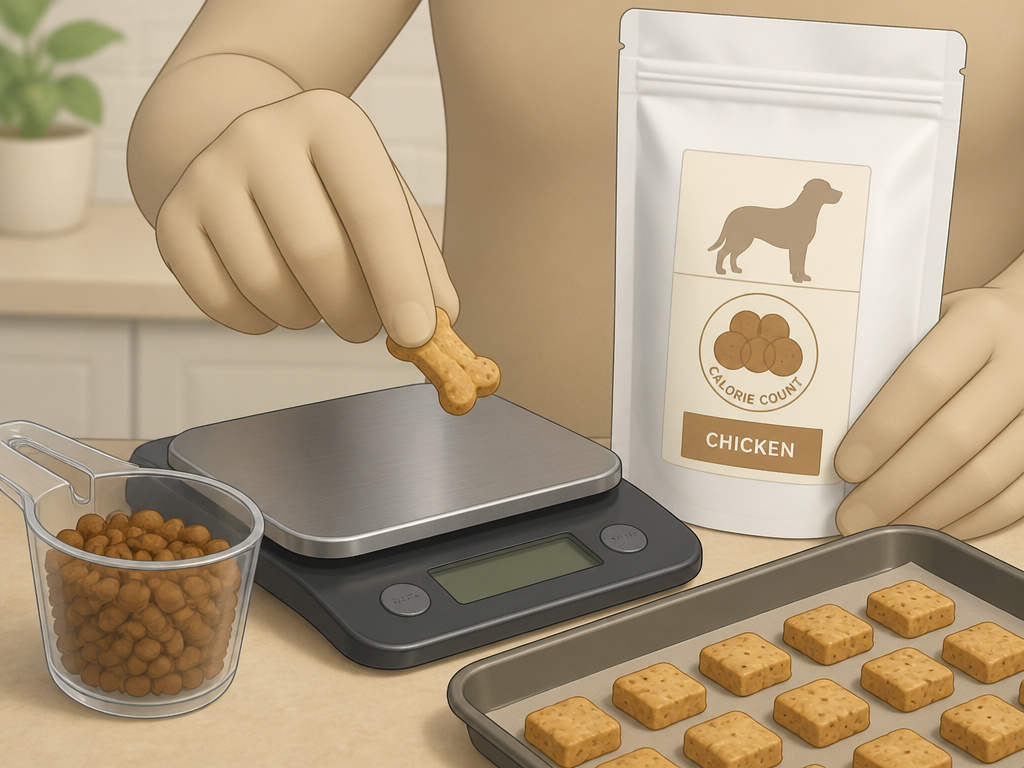
Here is the version I’d write on the back of a receipt.
Keep the complete diet as the base and use everything else as a topper or a reward. That’s boring and it works every time. Most homemade recipes I get asked about are fine as treats and a disaster as meals, because they weren’t built to be complete.
If your dog is on a prescription food, the safest treat is a measured portion of that same food, pulled from the daily ration rather than added on top. VCA’s suggestion of baking the matching canned version into small pieces is the next best option, and it keeps the protein profile identical.
For a dog without a confirmed diagnosis, the default is a treat with a stated calorie count, a named protein, and a manufacturer who will answer a question about it. So does a plain biscuit, weighed against the budget rather than handed out by feel.
What I’d skip: grain-free treats sold as an allergy solution. A grain-free label tells you what’s absent, not what protein is in the bag. If your dog reacted to chicken, a grain-free chicken treat is still a chicken treat.
Frequently Asked Questions
Can a dog with allergies have peanut butter?
Only if peanuts aren’t the suspect and the jar contains nothing but peanuts. Xylitol is on WSAVA’s toxin list, so check the label, and weigh it into the calorie budget like any other treat rather than treating it as free. Weigh it into the calorie budget like any other treat rather than treating it as free.
How long does it take for a reaction to show up after a new treat?
It varies more than most owners expect. In one prospective study of 46 dogs, median time to relapse after a dietary challenge was 12 hours, with a range from 1.5 hours to 10 days. A retrospective review found only 9 percent of dogs flared within 24 hours, with half flaring by 5 days and 90 percent by 14 days.
Are grain-free treats better for an allergic dog?
Grain-free claim tells you what the product leaves out, not what protein it contains. Food allergy management centers on identifying and avoiding the specific protein your dog reacts to, so a grain-free treat built on the same suspect protein solves nothing. Read the named protein, not the grain claim.
Can I give my allergic dog the same treats my other dog eats?
Keep separate bags and separate hands, or run the trial with both dogs on the same matched treat.
What if my dog is on a prescription diet?
Ask the veterinary team before adding anything. WSAVA’s position is that conventional treats may not be appropriate for a dog on a veterinary-prescribed diet, and VCA notes some therapeutic diets may not work properly if extra food items are fed. The treat can defeat the reason for the diet, not just add calories.
The Bottom Line
The trigger for action is simple. If your dog’s itching hasn’t settled on a strict treat protocol, stop guessing and book the vet visit, because the retrospective data says 90 percent of food-allergic dogs flare within 14 days and you should have seen a change by then.
One thing to do this week: write down every item that goes in your dog’s mouth for seven days, including the training rewards, the pill wrap, and the crust someone else in the house handed over. That list is the single most useful thing you can bring to a veterinary appointment, and almost nobody brings it.
One concession, and it’s an honest one. My own work centers on commercial cat food formulations, so canine therapeutic diets are thinner ground for me. Where a dog is on a prescription food for kidney, urinary, or diabetic management, follow the veterinary team and the manufacturer, not a label comparison from someone who spends most of his week reading feline panels.
Read it twice. Then go read the back of the bag.
