
Catnip Treats Guide: Calories, Safety, and Recipes
This post contains affiliate links. As an Amazon Associate, we earn from qualifying purchases.
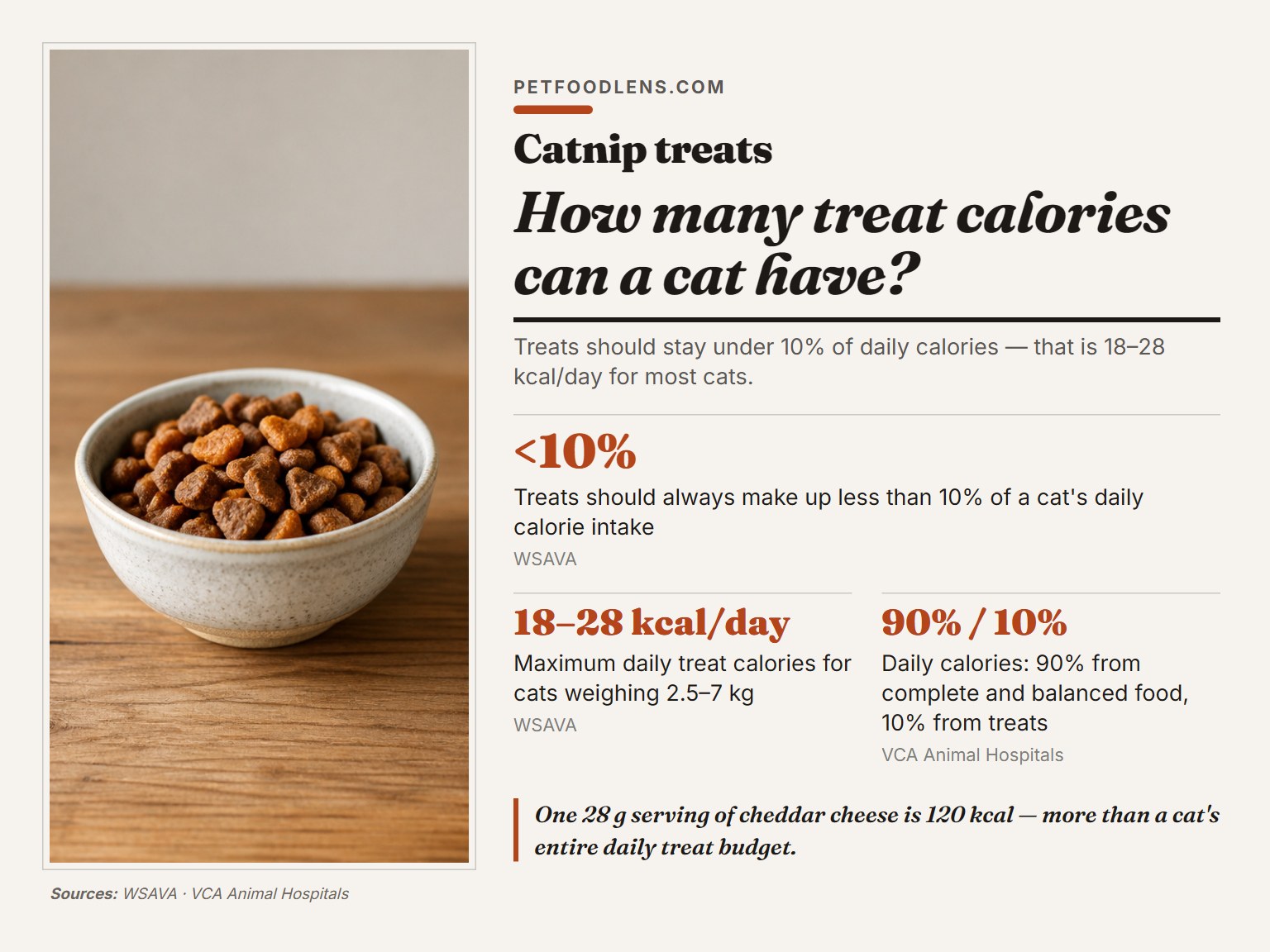
A catnip treats guide starts with the calorie ceiling: treats must stay under 10% of a cat’s daily calories, which is 18 to 28 kcal for cats weighing 2.5 to 7 kg, per the WSAVA. About one in three cats ignore catnip, and the Zoetis recipe bakes at 350°F for 10 minutes, flips, then 10 more.
The 2.5 kg end of that table gets 18 kcal a day from treats; the 7 kg end gets 28. The distance between what a treat feels like to hand over and what it costs on that table is where this whole subject lives.
What follows: the calorie math by body weight, the measured response rates for catnip and its alternatives, a sourced recipe with real bake times, and the four situations where the 10% rule stops being enough.
Key Takeaways
- Treats cap at 10% of daily calories, which WSAVA’s table renders as 18 kcal for a 2.5 kg cat and 28 kcal for a 7 kg cat.
- About one in three cats show no response to catnip, and roughly 75% of those non-responders do respond to silver vine (Bol et al., 2017).
- The Zoetis recipe bakes at 350°F for 10 minutes, flips, then 10 more, and shapes into ¼-teaspoon balls.
- Bones and raw animal-based treats sit on WSAVA’s unsafe list, no matter how the packaging frames them.
- A prescription diet changes the arithmetic, and VCA warns urinary diets may stop working properly once treats are added.
Catnip Treats Guide: How Many Can a Cat Have a Day?
Eighteen kilocalories. That is the entire daily treat allowance for a 2.5 kg cat.
I learned to work in calories the slow way. For my first couple of years I treated the feeding guide on the back of the bag as the starting point for portions, and the numbers looked sane until I ran them against calories per cup. The guides ran hot for indoor cats almost every time. Now the calorie figure comes first and the scoop size gets derived from it, treats included.
The 10% ceiling is calculated against total daily calorie intake, not against body weight directly. WSAVA publishes a body-weight table as a shortcut for average healthy adult cats in ideal body condition, and directs owners to their veterinary team when age, activity level or condition puts a cat outside that average.
| Cat’s body weight | Max calories from treats per day |
|---|---|
| 2.5 kg | 18 kcal |
| 3 kg | 20 kcal |
| 4 kg | 22 kcal |
| 5 kg | 25 kcal |
| 6 kg | 26 kcal |
| 7 kg | 28 kcal |
The full WSAVA table runs from 2.5 kg to 7 kg in half-kilo steps and tops out at 28 kcal. Note that 5.5 kg and 6 kg both land on 26. The curve flattens, which is worth remembering when someone tells you a bigger cat can “handle a few more.”
Now the practical snag. Plenty of commercial treats do not print a kcal-per-piece figure on the pack. WSAVA’s guidance for that situation is blunt: contact the manufacturer. VCA points owners to the package label first, then to the USDA Food Database for anything coming out of the kitchen.
If you want the arithmetic worked through for a specific body weight and a specific treat, this walkthrough of the daily treat limit does it step by step.
Here is what the allowance actually buys. WSAVA lists 1 oz of cheddar cheese at 120 kcal and notes that for many cats, one serving of a listed human food can blow past the entire daily treat budget. A 4 kg cat gets 22 kcal. One ounce of cheddar is more than the entire daily allowance.
Which is why the kcal-per-treat number belongs in your head before the bag goes in the basket, and our guide on how to choose cat treats walks through the label checks. Marketing is not nutrition, and a “light” label is not a calorie count.
Why Roughly One in Three Cats Ignores Catnip
Bol et al. Tested 100 domestic cats and found that one in three showed no response to catnip at all. The study, published in BMC Veterinary Research in 2017, also ran nine tigers through the same protocol.
The response is inherited. A cat either has the sensitivity or it doesn’t, though Ueno et al. Found that dried silver vine leaves enhance the response and fresh and dried are not interchangeable, while The Conversation treats fresh or dried catnip as interchangeable options. What changes is which plant you offer.
| Plant | Cats that respond | Note |
|---|---|---|
| Catnip (Nepeta cataria) | Roughly two in three | Highest nepetalactone concentration |
| Silver vine | ~80% | ~75% of catnip non-responders respond |
| Tatarian honeysuckle | ~50% | About 1 in 3 catnip non-responders respond |
| Valerian root | ~50% | Response rate similar to honeysuckle |
Look at the nepetalactone column and the ranking gets strange. Bol et al. Measured nepetalactone with GC-MS and found it highest in catnip, with only marginal levels in silver vine, honeysuckle and valerian. Silver vine still pulls the highest response rate of the four despite carrying almost none of the compound catnip is famous for.
Something else is doing the work in those plants. The Conversation’s academic commentary notes that silver vine, valerian and Tatarian honeysuckle can all serve as alternatives when catnip does nothing.
The catnip response is inherited. A cat that walks away from the bowl is telling you about its genetics, not about your shopping choices.
Here is where the sources split, and you should know both numbers. VCA Animal Hospitals states that approximately 50% of cats do not respond at all. Bol et al. Measured one in three. Two credible sources, a real gap between them, and no reconciliation published that I can find. I lean toward the measured figure from the 100-cat sample, but I would not call the question settled.
Why Nepetalactone Hits Some Cats and Not Others
Zoetis Petcare describes nepetalactone as stimulating a sensory response in the brain similar to smelling another cat’s pheromones. That is a proposed mechanism, not a confirmed one, and the company presents it as a belief rather than a finding.
The behaviour itself is easy to spot once you know the shape of it. The Conversation’s list of observed responses includes licking, head-shaking while carrying plant material, drooling, hind-foot kicking, and a wavelike ripple of skin down the back as muscles contract and relax.
That ripple is the tell. A cat doing it is responding; a cat sniffing once and walking off is not.
If your cat falls in the second group, the useful move is switching plants rather than brands, and our silvervine for cats guide covers the crossover rates. Silvervine for cats covers the crossover rates and how to introduce it. For cats that respond to nothing at all, treats for picky cats is the other angle worth trying.
Inside the Zoetis Catnip Treat Recipe
Open a bag of dried catnip in a small kitchen and the smell arrives first: dusty, hay-like, faintly minty, closer to a hayloft than a spice rack.
The Zoetis Petcare recipe is the one most home bakers start with, and it is unusually specific for a brand blog. The ingredient list is ½ cup whole wheat flour, ½ cup nonfat dry milk powder, ½ can tuna in oil, 1 tbsp vegetable oil, 1 egg, ¼ cup water, and ¼ cup crushed dry catnip.
Before you start: Raw egg and canned tuna go into this dough, so wash hands and boards after shaping (the bake handles the egg, the counter does not). Finished treats stay refrigerated in an airtight container, per Zoetis. Skip the recipe entirely if your cat has a diagnosed food allergy, because wheat flour and milk powder are both common triggers.
The Method, Step by Step
- Mash the tuna until it is smooth before anything else goes in. Chunks left whole will not break down later, and you end up with uneven treats that bake at different rates.
- Stir in the flour and milk powder, then the oil, then the beaten egg and water. Skipping the separate egg beating leaves streaks of egg white that never incorporate, and those pockets bake hard.
- Shape into ¼-teaspoon balls and roll them in finely crushed dried catnip. This is the only quantified treat size in the source set, and it matters: WSAVA requires treats be an appropriate size and shape to reduce choking risk.
- Bake at 350°F for 10 minutes, flip, then bake another 10. Skipping the flip leaves the underside pale and soft, and soft centres are what go mouldy first in the fridge.
- Cool completely before storing. Warm treats sealed in a container steam, and the condensation turns the catnip coating into a damp paste.
The dough comes together soft and tacky, closer to a wet cookie dough than a biscuit. It will not hold a shape on its own, which is why the ¼-teaspoon measure is doing real work rather than being decorative.
If you would rather start from a different base, there are other homemade cat treats built around ingredients that skip the wheat entirely.
A quick honesty note on the timeline: Zoetis attributes the roughly 10-minute duration of the catnip effect to its own veterinary team, and that figure is not peer-reviewed. The Conversation describes the effects only as short-lived and gives no duration. Treat 10 minutes as a reasonable working number, not a measured one.
What WSAVA Says to Keep Out of the Bowl
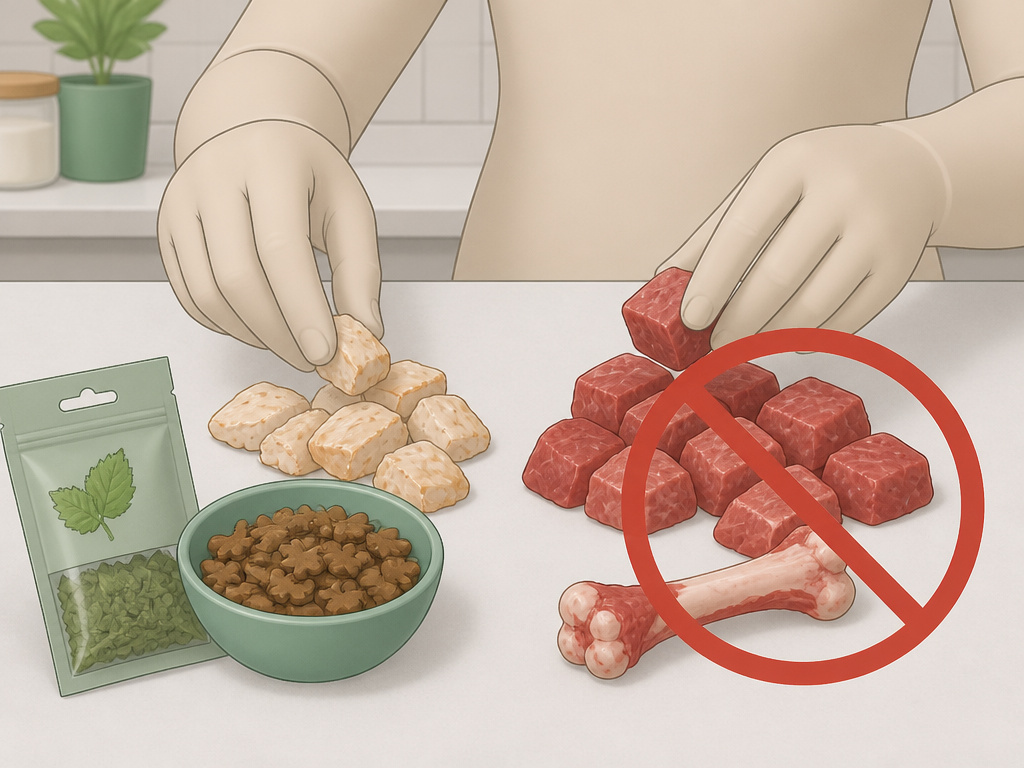
Bones are on the unsafe list. Cooked or raw, WSAVA’s position is that they can be very dangerous and cause significant damage if chewed or ingested.
Raw animal-based treats carry a separate problem: pathogen transmission. VCA extends that warning to freeze-dried and dehydrated raw treats specifically, noting the bacteria can spread through saliva and feces to other pets and to people in the home.
Split the types of cat treats into two piles and the safety questions sort themselves. Cooked and commercial on one side, raw and bone-in on the other.
The toxic-ingredient list is longer than most owners expect:
- Alliums: onions, leeks, shallots, garlic, chives. Onion powder hides in a surprising amount of human food.
- Grapes, raisins, currants and sultanas.
- Chocolate, plus xylitol, the sweetener that turns up in sugar-free everything.
- Alcohol and raw yeast dough.
- Caffeinated drinks, coffee, tea and energy drinks included.
- Milk and dairy, which WSAVA flags because many cats are lactose intolerant.
WSAVA’s own numbers make the calorie point better than any argument. One ounce of lean cooked chicken breast is 47 kcal. A 4 kg cat’s entire daily treat allowance is 22 kcal. That single ounce exceeds it.
A “natural” claim on the front of the bag does not move an item off this list, so check our natural cat treats picks against the same safety bar. Natural cat treats still have to clear the same safety bar, and the word natural has no agreed nutritional definition behind it.
What most people get wrong: Reading “single ingredient” as “safe.” A single-ingredient raw liver treat is still a raw animal-based treat, and WSAVA’s pathogen warning applies to it exactly as written.
When the 10% Rule Stops Being Enough
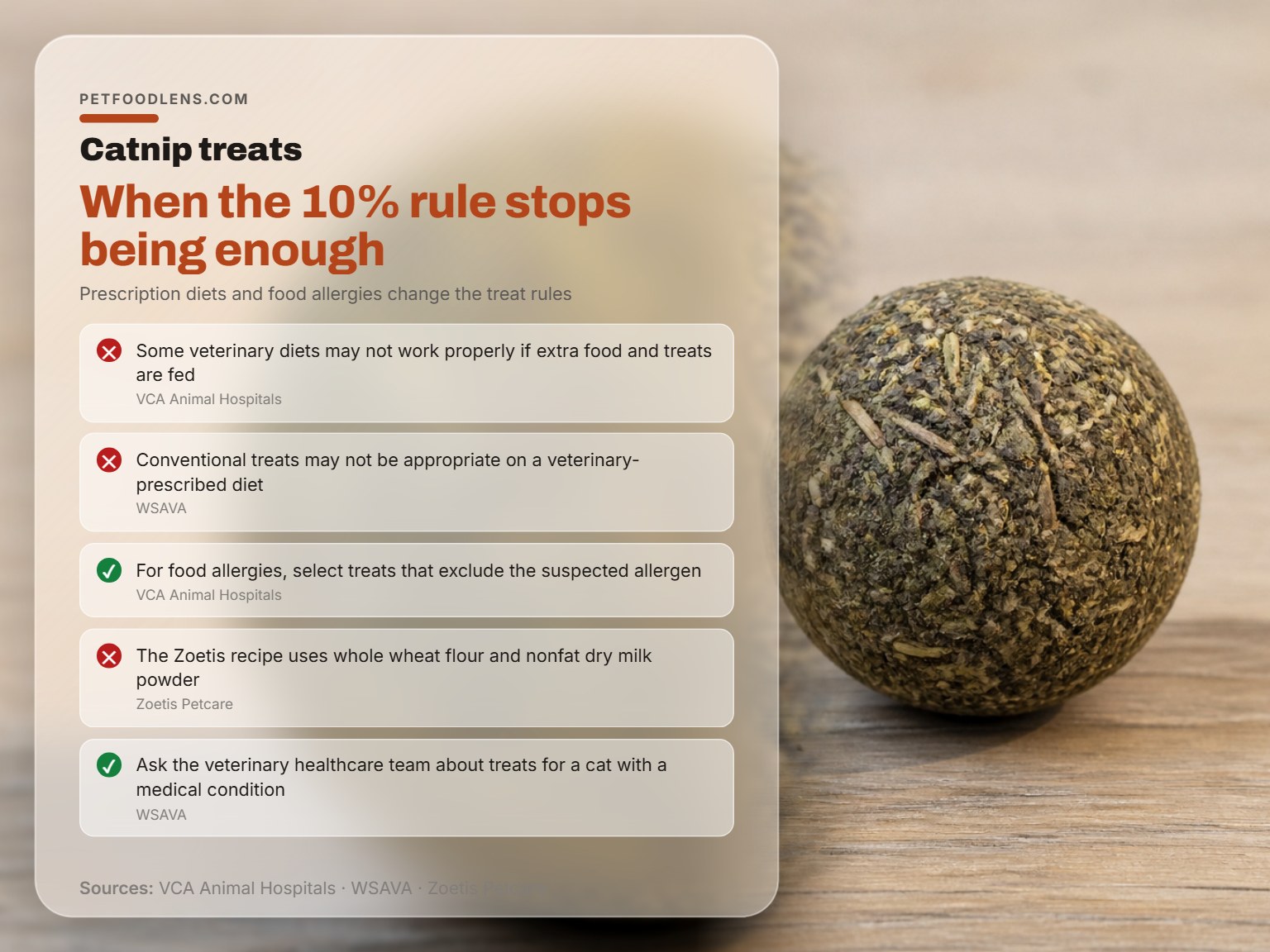
The 10% ceiling protects the balance of a normal diet. A prescription diet is doing a different job, and the ceiling does not cover it.
VCA is direct about this. Some veterinary diets may not work properly if additional food items and treats are fed, and prescription urinary foods are the named example. In those cases a veterinarian may recommend a prescription treat designed to work alongside the food.
WSAVA reaches the same place from the other direction. If a cat has a medical condition, dietary sensitivities, or is on a veterinary-prescribed diet, conventional treats may not be appropriate, and the guidance is to ask the veterinary healthcare team.
Food Allergies and Prescription Diets
For a cat with a diagnosed food allergy, VCA’s instruction is to select treats that exclude the suspected allergen. That rules out the Zoetis recipe for wheat- or dairy-sensitive cats, since whole wheat flour and nonfat dry milk powder are the first two ingredients.
I am not a veterinarian and I do not play one on this topic. Clinical diets for kidney disease, diabetes or urinary conditions sit outside what I can responsibly advise on. The formulation logic I can explain; the therapeutic decision belongs to your vet.
There is a documented gap between what owners do and what the guidance says. A cross-sectional survey of 337 cat caregivers in Canada and the US recorded feeding of jerky, bones, dental treats and table scraps, all of which the standards bodies flag as unsafe. The cat caregiver treat feeding survey is worth reading if you want to see how wide that gap runs.
Easy to miss: A prescription diet plus “just a few” treats is still a prescription diet plus treats. The 10% ceiling was never designed to protect therapeutic efficacy, and VCA’s warning about urinary foods is the clearest statement of that limit in the source set.
Which Cat Treats Actually Earn a Place in the Cupboard?
Buy the treat that prints a calorie figure. Skip the one that will not tell you.
That single filter eliminates most of the shelf. WSAVA’s fallback is to phone the manufacturer when the label is silent, and that instruction exists because silence is common.
For dental chews, choose a product that prints a calorie figure. They are not calorie-free, so they come out of the same 10% budget as everything else. The other thing to look for is a treat whose manufacturer publishes calorie information alongside the product rather than burying it.
For a cat that needs calming support rather than a snack, see our calming treats for cats, though that belongs in the conversation with your vet rather than in the treat jar.
Where I would push back on the marketing:
- Freeze-dried single-protein treats get sold as the premium option. They cost more and they are not nutritionally superior to cooked equivalents, and VCA’s raw-contamination warning applies to the freeze-dried raw versions.
- “Light” and “lower calorie” labels are not significantly lower in calories than other treats, per VCA. The label is doing persuasion, not arithmetic.
- A portion of the cat’s regular food works as a training reward for food-motivated cats and keeps total calories predictable. VCA names this as a legitimate option, and it is the most underused one on this list.
If you want the comparison already done, the best cat treats roundup sorts by calorie transparency first.
Skip this if: Your cat is on a veterinary-prescribed diet. None of the picks above are cleared for that situation, and a prescription treat matched to the food is the safer route.
Frequently Asked Questions
Do catnip treats count toward the 10% calorie limit?
Yes. WSAVA defines a treat as any food item given in addition to a complete and balanced diet, and that definition explicitly includes snacks, chews, supplements and foods used to give medication. A catnip biscuit is a treat by that definition, so it comes out of the same 18 to 28 kcal daily allowance.
How long does the catnip effect actually last?
Zoetis Petcare puts it at approximately 10 minutes, though that figure comes from a brand blog rather than a peer-reviewed study. The Conversation describes the effects only as short-lived and gives no duration. Zoetis gives approximately 10 minutes while The Conversation describes the effects only as short-lived with no duration, and The Conversation advises optimising the cat’s environment and lifestyle rather than relying on catnip alone.
Are catnip treats safe for cats on a prescription diet?
Not automatically. VCA warns that some veterinary diets, including prescription urinary foods, may not work properly once additional food items are added, and a veterinarian may recommend a prescription treat instead. WSAVA’s guidance is to ask the veterinary healthcare team before offering conventional treats to any cat on a prescribed diet.
What if my cat ignores catnip completely?
Try a different plant rather than a different brand. Bol et al. Found that roughly 75% of catnip non-responders did respond to silver vine, and about one in three responded to Tatarian honeysuckle. Valerian root sits at roughly 50% across the whole population.
Is silver vine safer than catnip?
The safety evidence is thinner than the marketing suggests. A controlled study on silver vine found no increase in blood markers of stress, hepatic or renal injury, and no addiction hallmarks under continuous exposure. The Conversation’s commentary reaches a similar conclusion for catnip and related plants, noting the evidence does not suggest psychosis, addiction or withdrawal, though the controlled silver vine study is limited to silver vine. Neither body of work is large.
Can I just use my cat’s regular kibble as a treat?
Yes, and VCA names it as a legitimate option for food-motivated cats. It keeps the calorie count predictable because you already know the number, and it sidesteps the label problem entirely. Measure it out of the daily ration rather than adding it on top.
The Bottom Line
Find the kcal-per-treat figure for whatever is in your cupboard this week. If the pack does not print it, email the manufacturer and ask, because WSAVA explicitly tells owners to do exactly that. Most will answer.
Then do the subtraction against your cat’s weight on the table above. That number, not the bag, is what decides how many pieces a day.
One concession worth stating plainly: none of this helps if your cat is on a prescription diet. The 10% ceiling was built to protect the balance of a normal diet, and a therapeutic diet is solving a different problem. That conversation belongs to your vet, and if you take one thing out of this catnip treats guide, take the part where I tell you to have it.
