
Types of Cat Treats: What Each One Actually Does
This post contains affiliate links. As an Amazon Associate, we earn from qualifying purchases.
The types of cat treats break into six practical groups: crunchy biscuits, soft and chewy pieces, dental chews, freeze-dried and raw pieces, lickable purees, and single-ingredient meat or fish. The group decides calorie density, the texture a cat can actually work through, and how much of the daily ration the treat displaces.
That grouping matters because the treat ceiling everyone quotes is a calorie rule, and calorie density is what separates the groups. When you compare types of cat treats, a crunchy biscuit and a cube of freeze-dried liver look like the same mouthful in your hand. On a kitchen scale they are two different decisions.
What follows: the six groups and what each one actually does, the calorie math behind the 10 percent figure, and the two categories that carry genuine risk.
Key Takeaways
- Treats should stay under 10% of daily calories. WSAVA’s table puts the ceiling at 18 to 28 kcal a day for cats between 2.5 and 7 kg.
- Treats are not required to meet complete-and-balanced standards, so a treat that replaces a meal creates a nutrient gap rather than a swap.
- Texture is a health decision. Crunchy suits a cat with healthy teeth; soft or puree suits seniors and cats with dental disease.
- “Light” and “lower calorie” labels are not meaningfully lower in calories, according to VCA Animal Hospitals.
- Raw and freeze-dried raw treats carry bacterial risk to the cat and to the people handling them.
The Six Types of Cat Treats, Sorted by What They Do
A 2020 in vitro study in Translational Animal Science sorted 25 commercial treats into six categories: biscuit, chew, dental, meat product, rawhide, and cat treat.
Dry matter disappearance measures how much of a treat breaks down under simulated stomach and intestinal conditions. Across 25 commercial products, intestinal-phase dry matter disappearance was generally above 85% for several treat categories, while rawhide varied from 35.10% to 95.70%. A low gastric figure flags a treat that stays intact long enough to obstruct, particularly one of large size.
That lab figure is a stand-in for digestibility, and the spread between products was enormous. Some treats essentially dissolved. Others sat there.
| Treat type | Texture | What it does |
|---|---|---|
| Crunchy biscuit | Dry, snaps cleanly | Fast reward, some scraping action |
| Soft and chewy | Moist, tears apart | Training, pill hiding |
| Dental chew | Firm, needs work | Plaque and tartar control with a VOHC seal |
| Freeze-dried or raw | Light, crumbles | High-value reward, bacterial risk |
| Lickable puree | Gel or liquid | Moisture, seniors, medication |
| Single-ingredient meat | Dried or cooked | Simple protein, easy to overfeed |
Two of those categories transfer cleanly to cats. Biscuits and dental chews are the ones stacked at eye level in the aisle. Rawhide is a dog category that shows up in cat packaging as a novelty, and the study’s own data flagged it as the outlier, with dry matter disappearance running from 35.10% to 95.70%.
I’ll take the six-category split over the aisle’s version any day. The aisle sorts by flavor and packaging. This sorts by what the piece does in the mouth and the gut.
For a cat, the useful split comes down to three questions. How hard is the piece, how many calories does it carry, and does it do anything past tasting good.
Purpose drives the pick more than category does, and choosing cat treats by job rather than by shelf is the faster route.
A soft chewy piece and a freeze-dried cube can weigh the same and land in completely different places on the calorie count. Which is why the kcal-per-piece figure matters more than the photograph on the front.
How Many Treat Calories Can a Cat Actually Have?
The WSAVA Global Nutrition Committee publishes a body-weight table rather than a single number, which is the part most treat packaging leaves out.
| Cat’s body weight | Maximum treat calories per day |
|---|---|
| 3 kg | 20 kcal |
| 4 kg | 22 kcal |
| 5 kg | 25 kcal |
| 6 kg | 26 kcal |
| 7 kg | 28 kcal |
Those figures come from the WSAVA guide to feeding cat treats, and they assume an average healthy adult cat in ideal body condition. A cat already carrying extra weight needs a lower number. A cat on a prescription diet needs a number from the vet who set the diet.
VCA Animal Hospitals frames the same ceiling from the other direction. Ninety percent of daily calories from complete and balanced food, 10% from treats. PetMD’s veterinary panel states it as a 10% cap on the daily diet.
The operational gap matters more than it looks. Treats at 10% can be read as a slice taken out of maintenance energy, or as an addition stacked on top of it. Those two readings produce different daily totals for the same cat.
Owners are not landing on either reading. In a survey of 337 cat caregivers, the median estimate was 15% of the diet from treats, with a range from 1% to 99%. Caregivers who counted every treat as extra landed at a median of 9%.
Measure treats by weight once, then stop guessing. Eyeball estimation was the most common method in that 337-caregiver survey, at 41%, and the reported median landed at 15% of the diet rather than 10%.
I keep the WSAVA table taped inside a cupboard door. Not because I forget the numbers, but because 25 kcal is a smaller pile of treats than most people picture. Two or three pieces, on a lot of products.
If you want the working version of that math, how many treats a cat can have in a day is worth pinning next to the table.
Where the 10 Percent Rule Breaks Down
In a 2025 study, 36.29% of diets built around dry snacks fell below crude protein minimums once 10% of calories came from treats.
The 10% figure is a calorie ceiling, and it assumes the remaining 90% is complete and balanced enough to absorb the cut. That assumption is exactly where the sources part company.
The WSAVA Global Nutrition Committee holds the ceiling as the safe rule and publishes it as guidance for healthy cats, while a 2025 study in MDPI’s Veterinary Sciences finds that in inactive cats the 10% rule can push diets below protein and fat minimums. A 2025 study in MDPI’s Veterinary Sciences reaches a narrower conclusion. In inactive cats, carving out 10% of calories pushed a large share of diets below nutrient minimums.
The failure rates were not evenly spread. Protein minimums were missed by 36.29% of dry-snack diets, 16.12% of wet-snack diets, and 2.41% of liquid-snack diets. Fat minimums failed at 29.03% for dry, 28.22% for wet, and 44.77% for liquid. Active cats met protein minimums across the board.
Read that again. The treat form changed which nutrient failed. Liquid treats had the lowest protein failure rate and the highest fat failure rate.
There is a second layer here that has nothing to do with calories. Regulators do not require treats to meet complete-and-balanced nutritional adequacy, as Today’s Veterinary Nurse points out. VCA says the same thing from the clinic side: many cat treats are not complete and balanced.
So a treat is not a small version of dinner. It is a separate product category with a lower regulatory bar.
Where this goes sideways: Running a 10% treat allowance on an indoor, neutered cat that is already on a weight-management food. The calorie cut comes off the food, and the food is the part carrying the protein.
I would rather see an owner keep the complete diet intact than hit 10% on a cat that barely moves. That is a judgment call, and the MDPI data is the reason for it.
Does the Texture of a Treat Actually Matter?
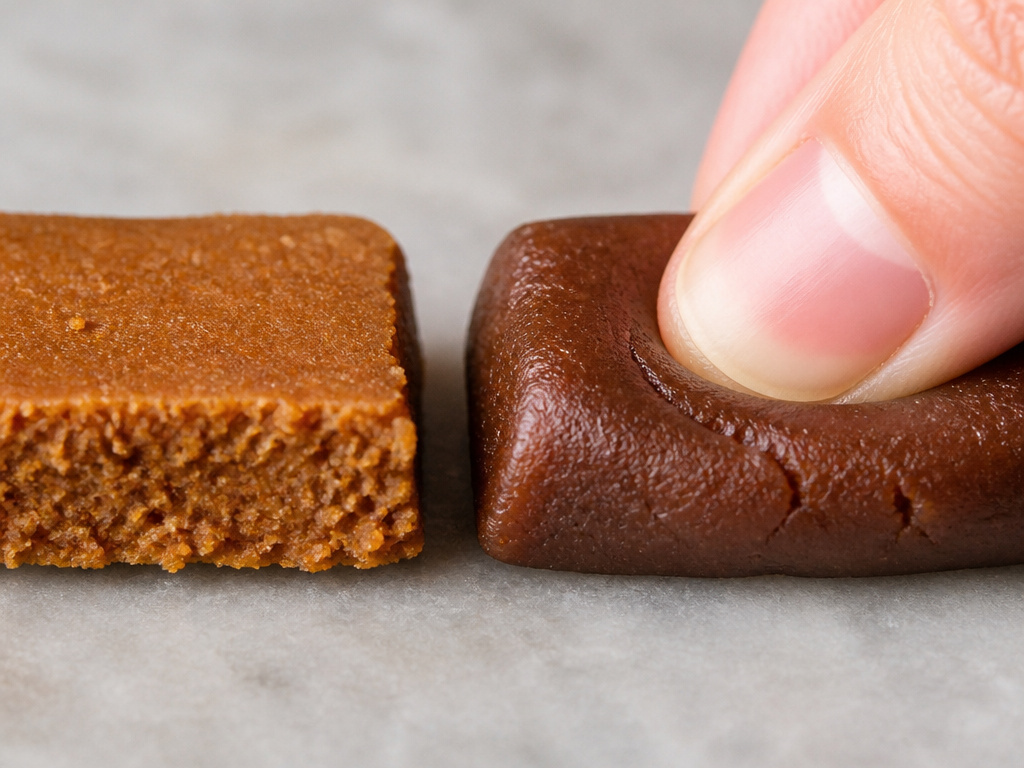
An older cat works a soft treat against the roof of her mouth for a few seconds, swallows, and asks for another. Hand her a hard biscuit and she drops it on the floor and walks off.
Texture gets filed under preference. It belongs under health, because the mouth doing the chewing is the thing you are trying to protect.
PetMD’s veterinary panel matches texture to the cat: crunchy for cats that already love dry food, soft or puree for seniors and cats with dental problems. That is a clinical sorting rule, not a flavor note.
When Crunch Beats Soft
Crunchy treats do mechanical work on the tooth surface, and that work is the entire basis for the Veterinary Oral Health Council seal. PetMD’s panel specifically values dental treats carrying it, because the seal certifies scientific proof of plaque or tartar control when the product is used as directed.
Dental treats with the VOHC seal are the ones to look for, and the VOHC accepted-products list is where you confirm current status rather than trusting the front of the bag.
Crunch also has a diagnostic value nobody talks about. A fresh crunchy treat gives a clean snap under the tooth. A stale one gives a dull thud. A cat that suddenly stops crunching is telling you something about its mouth.
When Soft Beats Crunch
A cat with missing molars, gingivitis, or a sore mouth gets nothing from abrasion. Soft textures are the practical answer there, and PetMD names seniors and cats with dental problems as the group that needs them.
Lickable puree treats are the reference product for the format, and they do something a biscuit cannot. It delivers moisture, and it can carry a pill.
Frozen treats need a warning. Today’s Veterinary Nurse notes that frozen food inside a rubber toy can harden past the point a tooth can take, and tooth fracture is a real outcome. A frozen treat should dent under a thumbnail before it goes to a cat.
What the Label Tells You, and What It Leaves Out
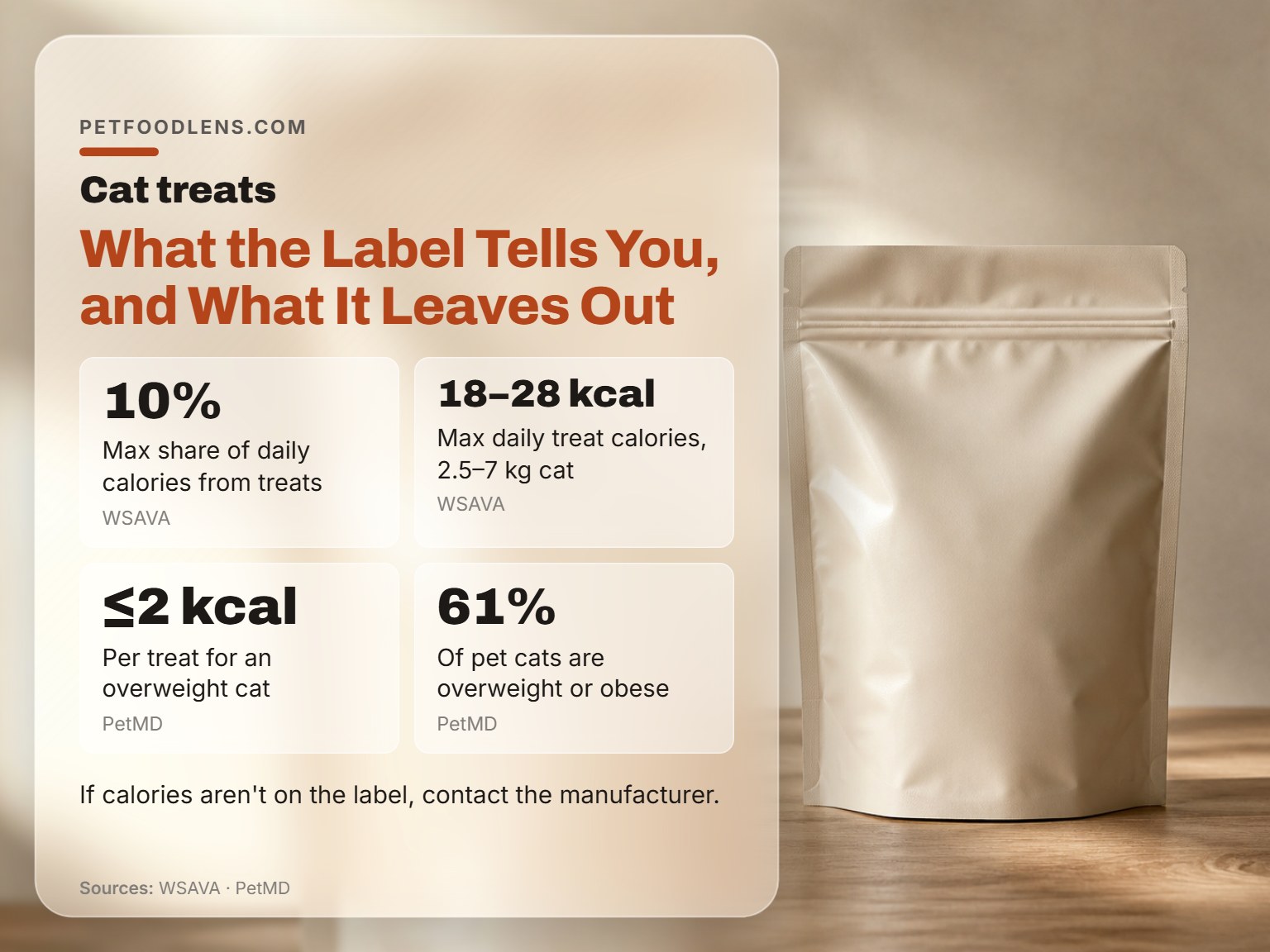
A treat label will hand you a protein percentage and hide the calorie count per piece.
I used to treat the crude protein number as the quality score. Big number, good product. Then I started finding high-protein treats built on vague or unnamed sources, and the single figure stopped telling me anything useful. I dropped the one-number approach and started reading the source and the full profile instead.
That habit transfers straight to treats. A treat built on a named meat meal and a treat built on something the label will not name are not the same purchase. The percentage is a total, not an origin.
Here is the part the front label skips. For commercial treats, WSAVA tells owners to contact the manufacturer for calorie information when it is not printed on the label. That instruction exists because the figure is frequently absent.
VCA adds a warning worth taping up. Treats labeled “light” or “lower calorie” are not significantly lower in calories than other treats. VCA says the words are not regulated in a way that changes the math, while PetMD’s veterinary panel recommends treats around 2 calories or less per treat for overweight cats.
PetMD’s panel puts low calorie at the top of its own selection criteria, and suggests roughly 2 calories or less per treat for an overweight cat. That is a workable target, and it is a target you can only hit if the package gives you a number.
A short checklist before anything goes in the basket:
- Find the kcal per piece. Not per kilogram, not per 100 g. Per piece.
- Read the first named ingredient. “Chicken” and “chicken meal” are different products with different water content.
- Check for a VOHC seal if the claim is dental.
- Skip the word “light” as a reason to buy.
Without it you are ranking packaging.
I will not buy a treat I cannot put a calorie figure on. If the bag hides it and the manufacturer will not answer, the product is telling me how it thinks about transparency.
The Two Categories That Carry Real Risk
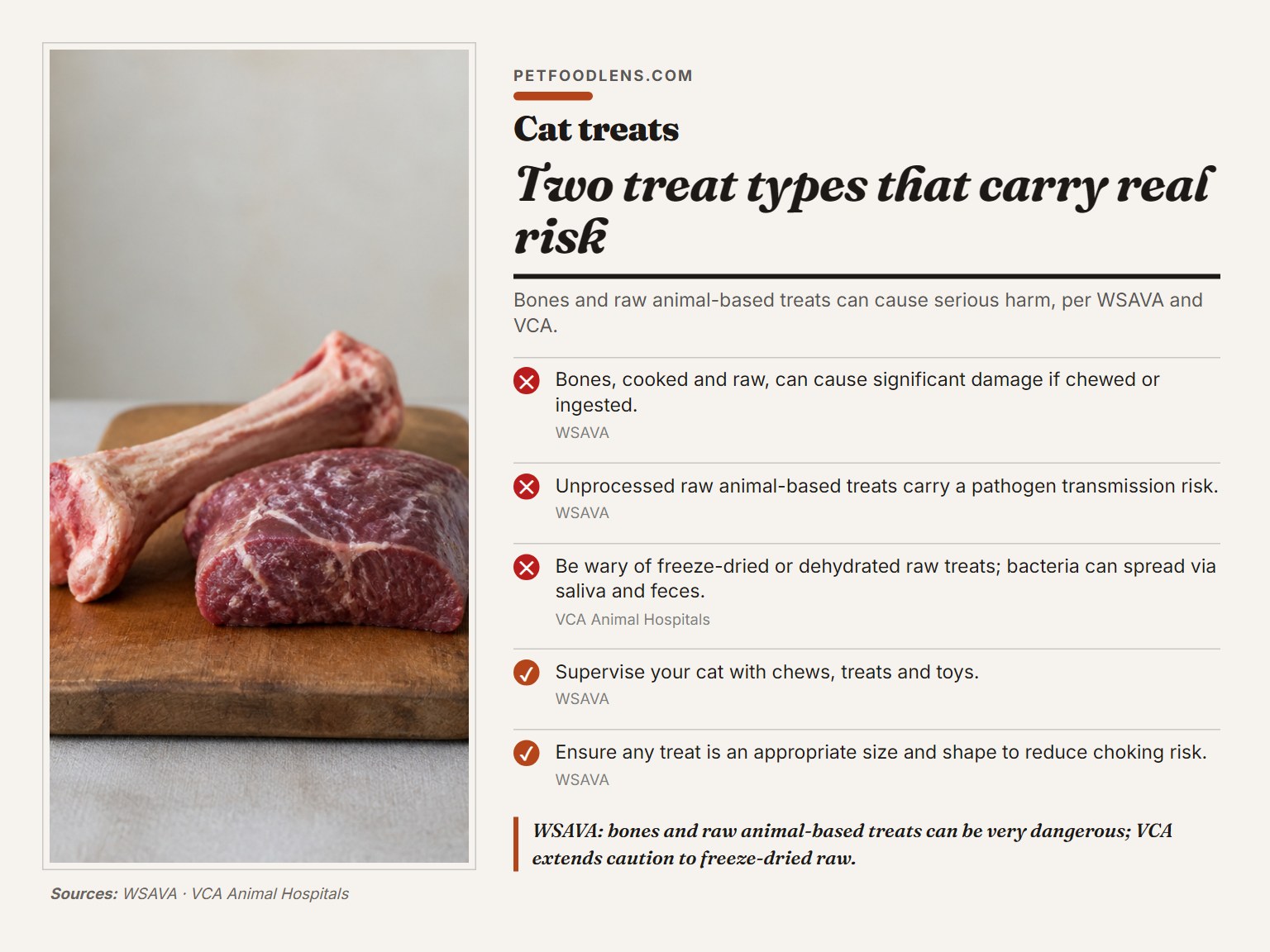
Two categories on this list can put a cat on an operating table.
The first is bone. WSAVA states plainly that bones, cooked and raw, can be very dangerous and cause significant damage if chewed or ingested by cats. That covers the cooked ones people assume are soft and the raw ones people assume are natural.
The second is raw and unprocessed animal-based product. WSAVA flags a pathogen transmission risk. VCA extends the caution to freeze-dried and dehydrated raw treats, because the bacteria can spread through saliva and feces to the cat, to other pets, and to the people in the house.
Bones, Raw Meat, and the Freeze-Dried Question
Freeze-dried pieces are light, crumbly, and shelf-stable. Work on sensory characteristics of freeze-dried treats tends to focus on what makes them appealing, which is a different question from what makes them safe.
Freeze-dried chicken and liver treats are common in that format, and the handling rules matter as much as the ingredient list. Wash hands after touching them. Keep the tub away from a cat’s water bowl.
I won’t feed a raw or freeze-dried raw treat to a cat in a house with an immunocompromised person or a young child. The risk is small and the downside is not.
Human food deserves its own line. WSAVA calls table scraps potentially dangerous, and the calorie figures back that up. One ounce of cheddar cheese runs 120 kcal. One ounce of lean cooked chicken breast runs 47 kcal.
The toxic list is short and worth memorizing:
- Onions, leeks, shallots, garlic, and chives
- Grapes, raisins, currants, and sultanas
- Chocolate
- Xylitol
- Alcohol and raw yeast dough
- Caffeinated drinks
- Milk and dairy products
That last one is contested: WSAVA groups milk and dairy with the toxic items and says consumption should be avoided because many cats are lactose intolerant, while most general veterinary sources treat dairy as inadvisable rather than toxic. WSAVA groups milk and dairy with the toxic items and says consumption should be avoided because many cats are lactose intolerant. Most general veterinary sources treat dairy as inadvisable rather than toxic. Both positions land in the same place for a cat owner, which is that cheese is not a treat.
There is also a vegetable caveat. Today’s Veterinary Nurse notes that carrots, celery, green beans, parsnips, and summer squash contain oxalate, so they should not be recommended for cats with a history of calcium oxalate stones.
Size and supervision close the loop. WSAVA says any treat should be an appropriate size and shape to reduce choking risk, and that cats should be supervised with chews, treats, and toys.
Common mistake: Leaving a chew or a large treat down as a distraction. WSAVA’s supervision guidance exists because a piece that stays intact through the stomach is the piece that blocks.
How to Work Treats Into a Daily Ration
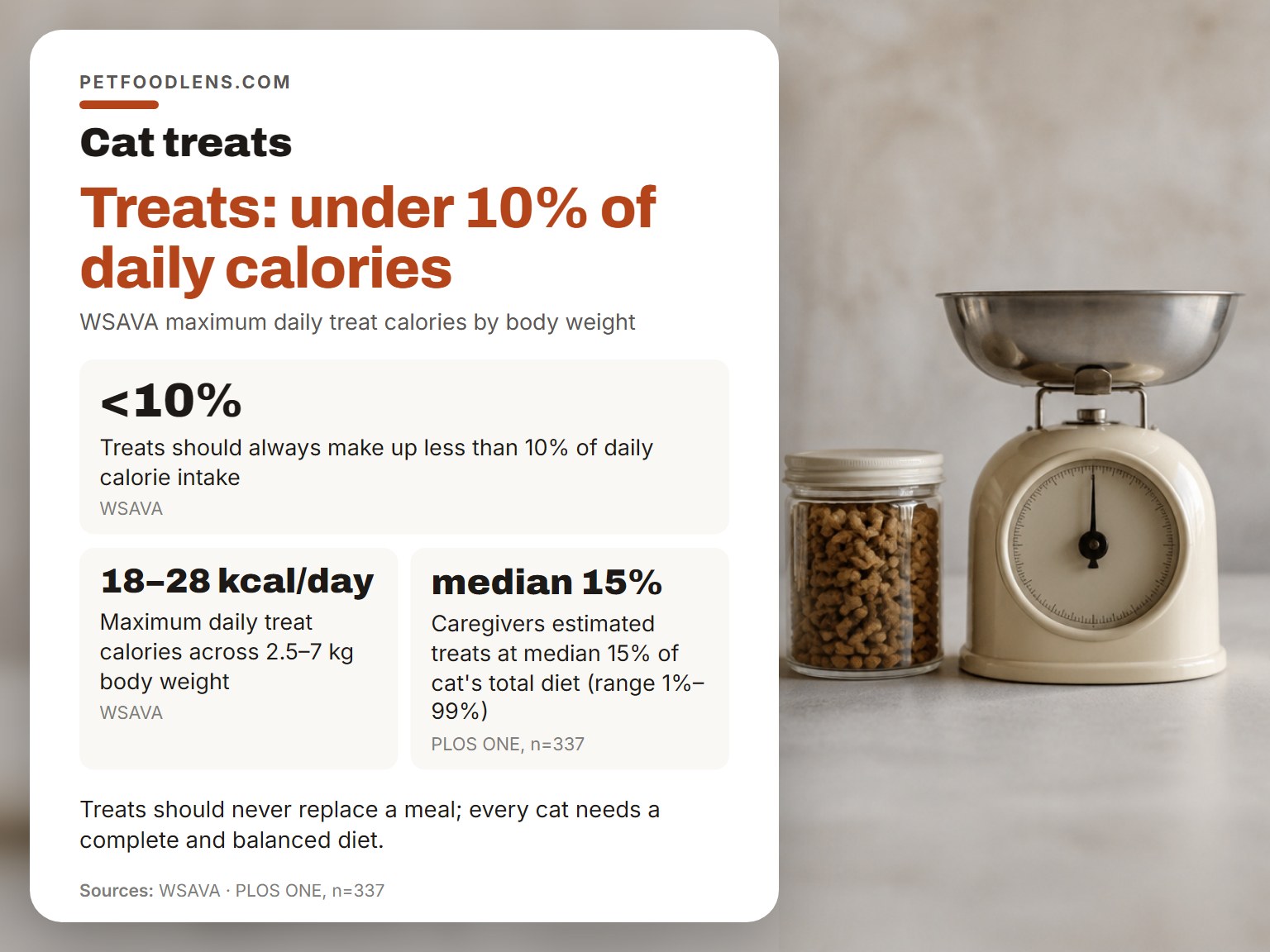
A daily ration with treats in it is a subtraction problem, and the subtraction has to happen before the treats get eaten.
Today’s Veterinary Nurse describes the cleanest version of this. Calculate the cat’s daily energy requirement, hold 10% of that total in a separate “treat” bag, and give from that bag through the day. The method reduces gastrointestinal upset because the treats come out of the same total rather than landing on top of it.
- Weigh the day’s food on a kitchen scale rather than scooping it.
- Take 10% out and put it in a separate container. That container is the treat budget.
- Close the container when it is empty. No refills until tomorrow.
- Log the format you used, because dry, wet, and liquid treats fail different nutrients.
- Recheck body condition monthly, not weekly. Weight moves slowly.
VCA offers a cheaper trick for food-motivated cats. Use a portion of the regular food as the treat. Many cats will not register the difference, and the calorie math stays predictable.
PetMD’s panel makes the same point from the other end: adjust the meal portion to account for treat calories so treats never exceed 10% of the total diet.
Worth knowing before you start: Training treats behaved differently from other categories in the survey data. A few times per week was negatively associated with perceived overweight, while daily table scraps and daily jerky were both positively associated with it.
That finding cuts against the blanket framing that all treats cause weight gain. Frequency and format carried more signal than the treat category itself.
The bag can hold whatever format your cat works for.
Most caregivers were estimating, and the estimates ran high.
Frequently Asked Questions
Are freeze-dried treats better than cooked ones?
Not on nutrition. Freeze-dried product is convenient and light, and the format carries a bacterial contamination risk that cooked treats do not. VCA specifically cautions on freeze-dried and dehydrated raw treats for that reason. If you feed them, treat them as a raw product in handling terms.
How many treats a day is too many?
Past 10% of daily calories, by both the WSAVA and VCA framings. For a 4 kg cat that ceiling is 22 kcal, which is a small number of pieces on most commercial products. Weigh it once and you will see the real figure rather than the imagined one.
Can cats have milk or cheese as a treat?
WSAVA groups milk and dairy with the items to avoid, citing lactose intolerance in many cats. Other veterinary sources treat dairy as inadvisable rather than toxic. Either way, one ounce of cheddar carries 120 kcal, which is several times a cat’s entire daily treat allowance.
Do dental treats actually clean teeth?
Only the ones with evidence behind them. The Veterinary Oral Health Council seal certifies scientific proof of plaque or tartar control when the product is used as directed, and PetMD’s panel weights that seal heavily. A crunchy biscuit without the seal is a snack, not a dental product.
Is it safe to give a cat raw meat treats?
WSAVA flags unprocessed raw animal-based treats as a pathogen transmission risk, and VCA extends the caution to freeze-dried raw. The calorie rule says nothing about this category, which is why it needs its own decision rather than a portion size.
The Bottom Line
Everything above assumes a healthy adult cat with a stable weight. Change either of those and the arithmetic changes with it. An indoor, neutered cat already carrying extra weight is the population where the 10% ceiling does the least good, because the cut comes off the food that supplies the protein.
So here is the version I would actually run this week. Weigh the day’s food, take 10% out, and put it in a separate container. That container is the treat budget, and it closes when it is empty.
The concession worth stating plainly: if your cat is on a veterinary-prescribed diet, none of the calorie math above is validated for you. WSAVA is explicit that conventional treats may not be appropriate on a therapeutic diet, and the 10% rule was never tested against one. Ask the vet who set the diet.
Fair enough, but one thing holds regardless. A treat you cannot put a number on is a treat you cannot budget, and that is the whole problem with the aisle.
