
Crunchy vs Soft Cat Treats: Which One Wins?
This post contains affiliate links. As an Amazon Associate, we earn from qualifying purchases.
Crunchy vs soft cat treats differ in texture, calories, and dental claims: only VOHC-accepted products carry a tested dental benefit, and most crunchy treats are not on that list. Soft treats suit cats that cannot chew, at roughly 6 kcal per Churu tube.
VOHC acceptance is granted one product at a time, for one claim at a time, after a study shows at least a 20% reduction in plaque or tartar against a control group. That structure is why a bag of fish-shaped kibble and a Greenies Feline Dental piece can sit on the same shelf and mean completely different things.
What follows covers the dental question, the calorie math, the dosing gap on dental treats, and the cases where soft wins outright.
Key Takeaways
- Only VOHC-accepted treats carry a tested dental claim. Crunchy texture by itself proves nothing about tartar.
- A 200-calorie cat gets about 20 calories of treats a day, which is ten pieces of a 2-calorie treat and a hard stop.
- Greenies Feline Dental is dosed by cat weight, up to 16 pieces daily, and that count collides with the 10% calorie cap.
- Inaba Churu runs about 6 kcal per 2 g tube and is grain-free, which WSAVA says is not inherently better.
- Soft treats are the right call for dental pain and pill hiding. They are the wrong call for cleaning teeth.
Do Crunchy Cat Treats Actually Clean Teeth?
The bag in front of you probably says something about helping to clean teeth. The only place that claim gets verified is the VOHC accepted products list, and most bags are not on it.
VOHC acceptance requires a controlled study showing at least a 20% reduction in plaque and/or tartar versus a control group. Acceptance is granted per product and per claim, so a tartar claim earned by one formula does not extend to other products sold by the same brand or in the same texture category.
Here is where the sources split, and it matters because the split is exactly what the marketing exploits.
| Source | Position on crunchy texture and dental benefit |
|---|---|
| Greenies (manufacturer) | VOHC-accepted for tartar control |
| VOHC (standards body) | Acceptance is product-specific and claim-specific |
| Pet Paradise (independent blog) | Texture alone does not prove dental benefit |
| Brindle Pet Supplies (retailer) | Dental treats support oral care; standard crunchy treats are rewards |
Read that table again. Three of the four positions agree that texture is not the mechanism. Only the manufacturer’s own accepted product carries a tested claim, and the claim belongs to that product, not to the category.
A crunchy treat makes a short, dry snap against the back molars. A soft one makes almost no sound at all, which is why a cat with sore gums stops crunching long before it stops eating.
Why ‘Crunchy Cleans Teeth’ Survives on Packaging
The FDA has issued warning letters and recalls over unapproved disease claims on pet treats and supplements, including claims to treat dental disease or tartar without VOHC acceptance or drug approval. That enforcement exists because the claim is valuable and easy to imply.
So the practical rule is narrow. If the package names a VOHC-accepted claim for that specific product, you have something. If it shows a picture of a tooth and says “crunchy,” you have a reward with a crisp texture. Most crunchy cat treats on the shelf fall into the second group, and the dental cat treats that carry a real claim are a short list.
What most people get wrong: Buying a crunchy treat because the front of the bag shows a tooth. Crunch is a texture, not a test result, and a cat fed an untested crunchy treat daily for years still builds tartar at the gumline.
One more wrinkle. Whiskas Dentabites was reported to have earned a VOHC tartar claim in 2017, but that comes from secondary reporting. Check the VOHC list directly before you treat it as settled.
How Many Treats Fit in a 200-Calorie Day?
Twenty calories. That is the entire treat budget for a cat that needs 200 calories a day, based on the 10% guideline veterinary nutrition sources repeat.
| Daily calorie need | Maximum calories from treats |
|---|---|
| 180 calories | 18 calories |
| 200 calories | 20 calories |
| 220 calories | 22 calories |
| 250 calories | 25 calories |
Now run the piece-size math, because this is where texture stops being the interesting question. Ten pieces of a 2-calorie treat deliver 20 calories. Ten pieces of a 5-calorie treat deliver 50 calories. Same handful, same chewing, more than double the load.
The number I look for first is kcal per piece, not kcal per bag. A bag statement tells you nothing until you divide by the piece count on the feeding directions.
Measure the day’s allowance in the morning and set it aside. That single habit does more for a cat’s waistline than any crunchy vs soft cat treats decision on this page.
Where Soft Treats Earn Their Place
Soft cat treats do two jobs well: they get a pill into a cat that will not swallow a tablet, and they feed a cat whose mouth hurts.
Veterinary client education from Cornell and the ASPCA supports soft and lickable treats for cats with dental pain and for medication administration. Pet Paradise is blunt about the other side of it: soft treats are not generally intended for dental cleaning. Both things are true at once.
Three jobs soft treats handle better than anything crunchy:
- Hiding a crushed tablet in a strong-smelling puree, which works on cats that spit out pills wrapped in food
- Feeding a cat with missing teeth, resorptive lesions, or a sore jaw after a dental
- Delivering a small, high-value reward to a cat on a tight calorie budget, because the piece size is controllable
The calorie argument for soft treats is weaker than the marketing suggests. Inaba Churu tubes run about 6 kcal each in a 2 g format, sold in 4-tube packs, and the manufacturer advises refrigeration after opening. Six calories per tube is not automatically lower than a crunchy piece. It depends entirely on the piece.
The Grain-Free Label on a Puree Tube
Churu is marketed as grain-free. WSAVA’s global nutrition guidance holds that grain-free is not inherently superior and carries diet-associated cardiomyopathy concerns in dogs, with the picture less established in cats.
I used to read grain-free as a signal of quality. When I actually compared labels side by side, the grains had usually been swapped for potatoes and peas, sometimes in large amounts. I stopped treating the term as shorthand for better.
That does not make Churu a bad product. It makes grain-free a marketing category rather than a nutritional verdict, and it belongs in the same bucket as “natural” and “premium.”
The hydration claim deserves the same scrutiny. Churu is a moisture-forward puree, and the manufacturer frames it that way. Cornell and ASPCA client education note that the water contribution is trivial relative to a cat’s daily needs. It is a soft boost, not a hydration strategy.
A 2 g tube of puree is a delivery vehicle, not a meal. If the cat needs water, the bowl is the answer.
The crunchy vs soft cat treats question leaves a smear on the plate that a crunchy one never does, and the plate needs a rinse before it goes back in the cupboard. Small thing, but it tells you what you are actually feeding.
If you are still sorting out which format suits your cat, the broader types of cat treats break down by texture and job rather than by brand.
The Greenies Dosing Gap: 16 Pieces a Day
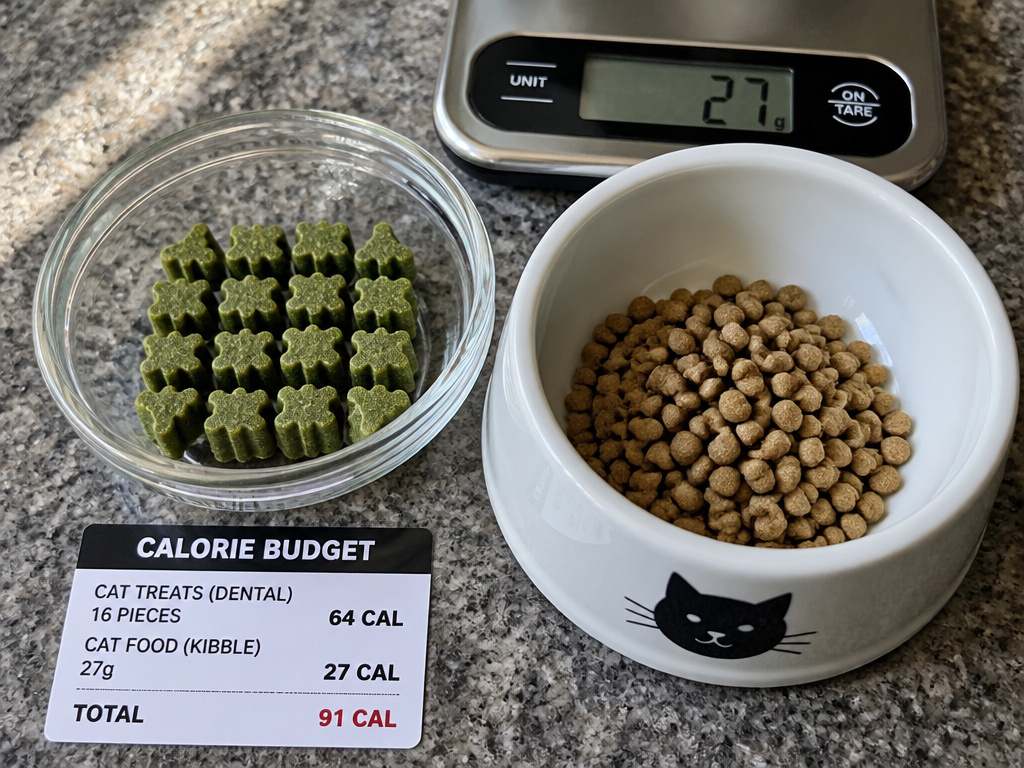
Sixteen pieces a day is the dose that earned the tartar claim.
Greenies Feline Dental is VOHC-accepted for tartar control, and the manufacturer’s feeding guidance calls for a specific number of pieces per day by cat weight to reach the tested effect. The up-to-16 figure circulating online is that dosing requirement. It is not a serving suggestion.
Here is the collision. Pet Paradise points out that treats should stay within roughly 10% of daily calories, which caps how many dental treats a cat can actually receive. Greenies says the benefit requires the weight-based count. Both constraints are real, and they do not always fit in the same day.
What the 10% Cap Does to a Dental Dose
Work it through for a 200-calorie cat with a 20-calorie treat budget. If each dental piece carries 2 calories, sixteen pieces exceeds the 20-calorie budget. If each piece carries fewer calories, sixteen pieces may fit within the budget. The label’s kcal statement decides it, and that statement is usually on the back.
I would rather see an owner feed a partial dose and brush twice a week than chase the full sixteen and quit inside a month. The dental claim is real, but it was tested in a regimen most households will not sustain.
Easy to miss: The dental claim is tied to the piece count, not to the bag. Two pieces as a casual snack deliver the calories without the tested effect.
How to Compare Two Treat Bags Side by Side
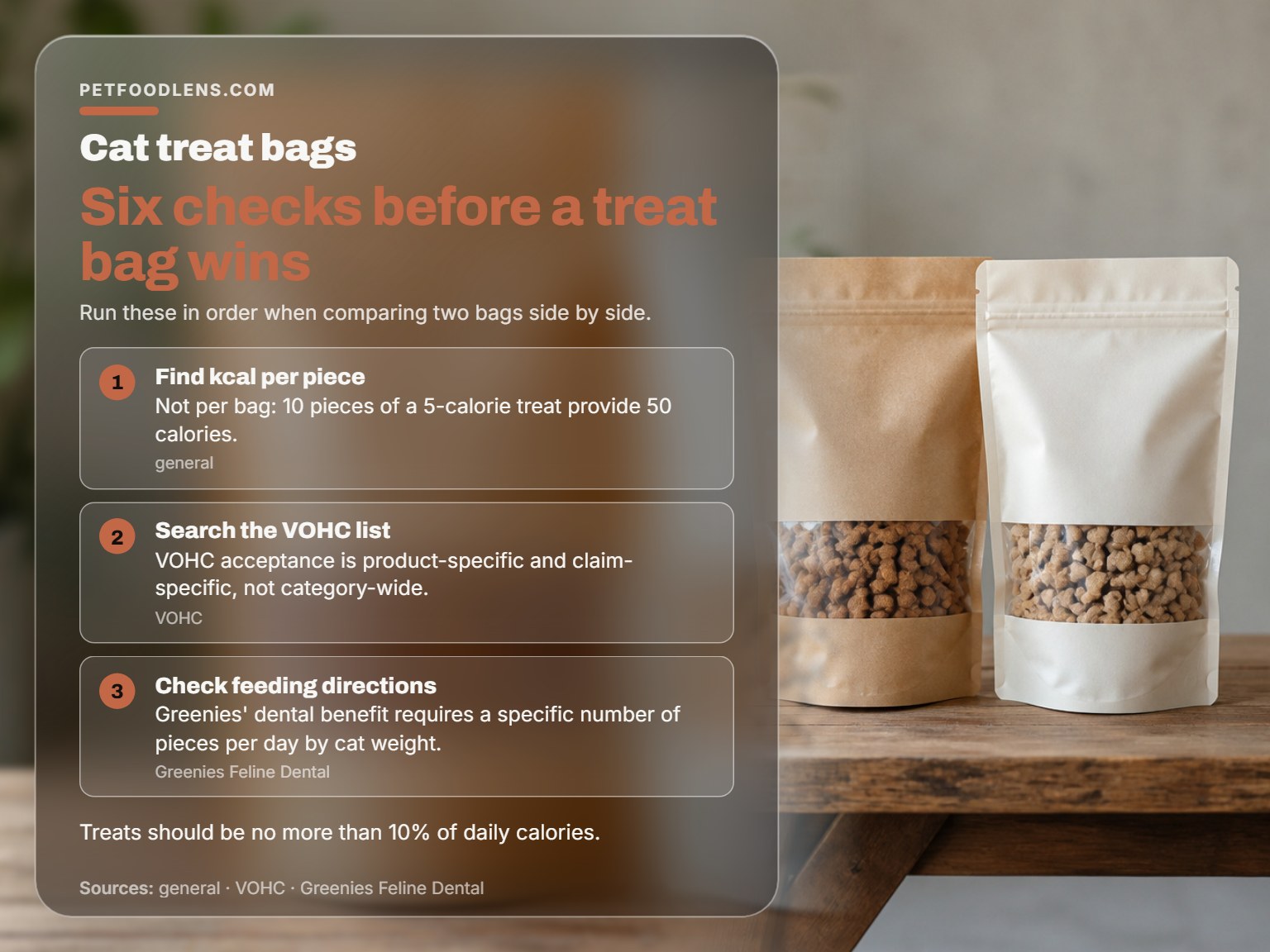
Which bag wins when you have thirty seconds and two products in your hands?
Run these six checks in order. Each one takes a few seconds, and skipping any of them is how a bag with a nice photo ends up in your cart.
- Find kcal per piece, not per bag. Skipping this means you cannot do the 10% math at all, and a 5-calorie piece quietly doubles your cat’s treat load.
- Search the exact product name on the VOHC list. If the product is not there, the dental language on the front is decoration.
- Read the first five ingredients for a named animal protein. If I cannot tell what the protein source is from the label, that is a flag for me. Clear naming is the minimum.
- Check the feeding directions for a piece count by weight. A dental product without a weight-based count is telling you the dose does not matter, which contradicts the claim.
- Check the life stage line. Kitten, adult, and all-life-stages are different answers, and a treat sized for an adult jaw is not automatically right for a kitten.
- Check the storage instruction. Crunchy treats are often shelf-stable in the original packaging or an airtight container. Soft treats vary, and Churu specifically calls for refrigeration after opening.
That sequence is the whole method behind how to choose cat treats in general, applied to two bags at once.
For everyday rewarding where dental claims are irrelevant, Temptations Super Mega Pack Seafood Medley in the 350 g pack is the classic crunchy reward, and Brindle’s own framing puts Temptations in the everyday category while Greenies sits in the dental category. Neither is a substitute for the other. If you want a wider spread of best cat treats by job rather than by brand, sort them that way first.
Kittens, Seniors, and Cats That Need a Softer Bite
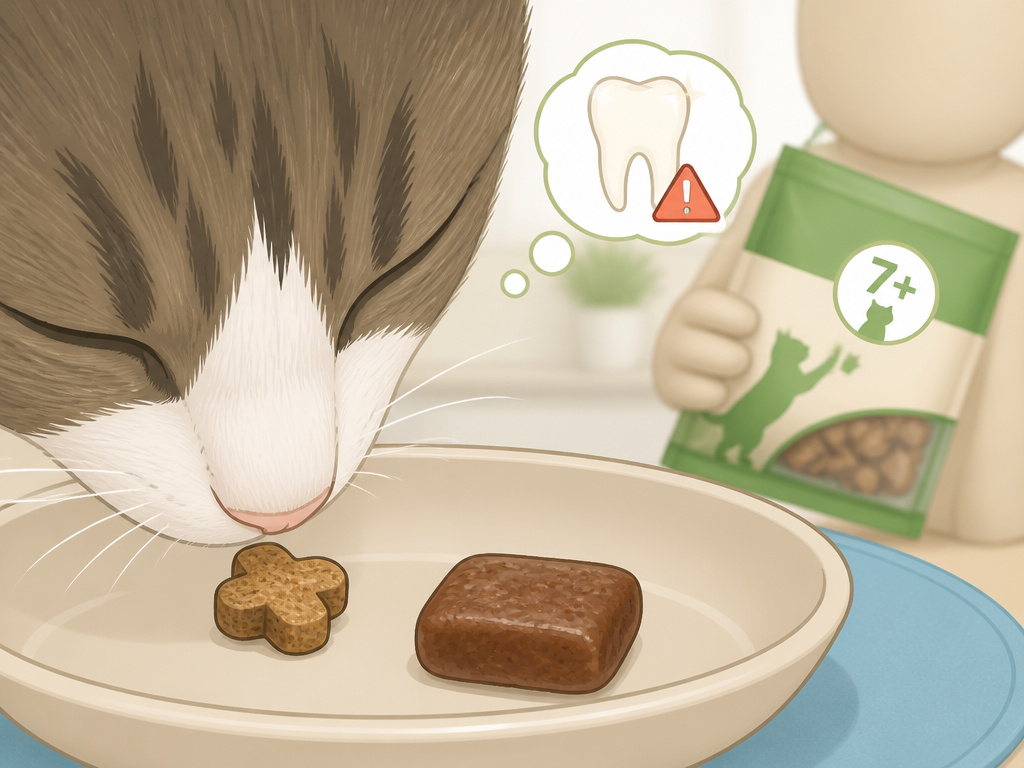
An older cat walks up to the bowl, sniffs the crunchy piece, and walks away. That is a data point, not a mood.
Pet Paradise flags sudden refusal of previously enjoyed crunchy treats in a senior cat as a possible sign of dental pain or another health issue, and recommends a veterinary exam rather than assuming pickiness. Brindle notes that soft and chewy textures may suit seniors better. Those two positions line up.
Kittens are where the sources diverge. Brindle says many crunchy treats are suitable for kittens once they are eating solid food, with a check on the manufacturer’s age recommendation. Pet Paradise warns that large or very hard treats may be difficult for a kitten to chew and should wait until the cat is developmentally ready.
Both end in the same place: read the age line on the package before you feed.
Signs to watch when you introduce any new treat:
- Coughing, gagging, or a cat that swallows without chewing, which is why supervision matters on the first few pieces
- Vomiting, diarrhea, or itching after a new treat, which means stop and call the vet
- A senior cat that suddenly quits a texture it used to finish, which points at the mouth before it points at preference
- A cat on a prescription diet, where any new treat needs a vet’s sign-off first
When Sudden Refusal Means a Vet Visit
If a cat that has eaten crunchy treats for years suddenly refuses them, do not spend two weeks waiting to see whether the mood passes. A dental exam costs less than the extraction that follows a chronic abscess.
If your cat has dental disease, a swallowing problem, or a medical condition that affects diet, ask your vet which texture is safest before you buy anything. That question is outside what a label can answer, and it is outside what I can answer too. I read formulations, not radiographs.
For older cats specifically, the senior cat treats question usually resolves to texture first and calories second.
Frequently Asked Questions
Are crunchy cat treats better for teeth than soft ones?
Only if that specific product carries a VOHC-accepted dental claim. VOHC acceptance requires a study showing at least a 20% reduction in plaque and/or tartar versus a control. Ordinary crunchy treats have no tested benefit, and soft treats are not generally intended for dental cleaning at all.
How many treats can a cat have per day?
Keep treats to about 10% of daily calories. A cat needing 200 calories gets roughly 20 calories of treats, which is ten pieces of a 2-calorie treat. Check kcal per piece on the label, because ten pieces of a 5-calorie treat is 50 calories and blows the budget.
Is grain-free important in a cat treat?
WSAVA guidance holds that grain-free is not inherently superior and carries diet-associated cardiomyopathy concerns in dogs, with the picture less established in cats. Inaba markets Churu as grain-free, which is a formulation choice rather than evidence of a health advantage.
Can I give a senior cat crunchy treats?
Yes, if the cat chews them comfortably. If a senior cat suddenly refuses a crunchy treat it used to enjoy, treat that as a possible sign of dental pain and book a vet exam rather than assuming pickiness.
Do soft treats help with hydration?
Only marginally. Cornell and ASPCA client education describe the water contribution of lickable treats as trivial relative to a cat’s daily needs. A Churu tube is a reward and a pill vehicle, not a water source.
What does the VOHC seal mean on a treat bag?
It means that specific product, for that specific claim, passed a controlled study showing at least a 20% reduction in plaque and/or tartar versus a control. It does not transfer to other products from the same brand, and it does not transfer to a different claim.
The Bottom Line
Before you buy another bag, do one thing. Open the VOHC accepted products list and search the exact product name on the package. If it comes back empty, you are buying a reward, and that is fine as long as you count the calories and stop expecting the tartar to disappear.
The threshold that decides most of this is simple. If a dental piece carries 2 calories and the cat’s budget is 20, you have ten pieces of room, and the sixteen-piece dose does not fit. Feed the partial dose, brush when the cat tolerates it, and stop treating the bag’s front panel as a test result.
One concession worth stating plainly: all of this changes if your cat has dental disease, a swallowing problem, or a prescription diet. In that case the texture question belongs to your vet, and no amount of label reading substitutes for the exam.
