
Liquid Cat Treats Pros and Cons: What Labels Skip
This post contains affiliate links. As an Amazon Associate, we earn from qualifying purchases.
Liquid cat treats pros and cons split along two lines: convenience and palatability on one side, calorie density and nutrient shortfall on the other. In one 2025 study of 124 cat diets, liquid snacks produced the highest fat-shortfall rate of any treat type, 44.77% in inactive cats.
Those two axes don’t point the same direction, which is why the liquid cat treats pros and cons get argued about so hard. The same dataset put liquid snacks at just 2.41% protein-shortfall, the lowest of the three treat types tested. Dry snacks failed the protein minimum in 36.29% of cases. Wet snacks failed in 16.12%.
What follows walks the format in order: what actually counts as a liquid treat, what the calorie math looks like against a 10% ceiling, where the palatability evidence contradicts itself, and which cats should skip the format entirely.
Key Takeaways
- Medication carriers count. WSAVA classes foods used to administer medication as treats, so a tube used to hide a pill spends the same daily allowance as a reward treat.
- Fat shortfall is the weak point. Liquid snacks hit a 44.77% fat-minimum failure rate in inactive cats, against 29.03% for dry and 28.22% for wet.
- Palatability evidence conflicts. One trial found liquid supplements highly palatable; a JAVMA flavor trial found 84.5% of water-based flavors rejected or only minimally accepted.
- Owners guess flavor wrong. JAVMA measured owner prediction of acceptance at a Kendall tau of -0.466, which is close to no predictive value at all.
- Neutered and indoor cats are the exception. The 2025 authors state that cutting food intake to make room for treats may not be ideal for them.
What Counts as a Liquid Cat Treat?
The category is wider than the shelf suggests. Squeeze tubes, puree pouches, lickable sticks, liquid nutritional supplements, and any liquid a pill gets hidden in all land in the same bucket.
Liquid cat treats include squeeze tubes, puree pouches, liquid nutritional supplements, and any liquid used to carry medication. Veterinary guidance classifies all of these as treats rather than food, which places each one inside the daily calorie ceiling instead of outside. The classification matters because a tube used to hide a pill still spends the same allowance.
WSAVA’s wording is explicit. Treats include “snacks, chews, supplements, and foods used to administer medication.” That last item catches people out, because a tube used to get a pill into a cat feels medical rather than recreational.
Here’s the practical list of what lands in the category:
- Squeeze tubes and lickable sticks, usually single-serve pouches sold as reward treats. Squeeze tubes are the format most owners recognize here.
- Puree pouches with a shorter ingredient list and no added thickener.
- Liquid nutritional supplements sold through veterinary channels for recovery support, which are dosed by millilitre rather than by piece.
- Medication carriers, including any liquid a crushed tablet gets stirred into.
- Homemade liquids, like the water drained off a can of tuna packed in water.
The calorie ceiling is the number that governs all of them. WSAVA publishes a body-weight table, and the range is narrower than most people expect.
| Cat body weight | Maximum daily calories from treats |
|---|---|
| 2.5 kg | 18 kcal |
| 3.5 kg | 21 kcal |
| 4 kg | 22 kcal |
| 5 kg | 25 kcal |
| 6 kg | 26 kcal |
| 7 kg | 28 kcal |
Those figures assume an average healthy adult cat in ideal body condition. WSAVA notes that a cat’s actual daily energy requirement should come from the veterinary team rather than a chart.
If you want the wider taxonomy before narrowing to liquids, the types of cat treats breakdown covers the crunchy, soft, and freeze-dried formats side by side.
The Calorie Math That Makes a Tube Add Up Fast
That’s a substantial share of the entire treat allowance in a single dose.
The same 30 ml supplies only 6.1% of the NRC 2006 protein maintenance requirement. So the volume is doing calorie work, not protein work.
That distinction matters more than it sounds. One 30 ml dose uses a meaningful share of it before the cat has done anything to earn a second one.
The tube gives a wet squelch when the last of it comes out. That’s usually the moment the whole dose has gone in.
Commercial squeeze tubes vary enormously here. WSAVA advises contacting the manufacturer directly for calorie information when it isn’t printed on the label, which is common on single-serve pouches. If you’re comparing formats, the squeezable cat treats roundup lists which brands publish a per-tube figure and which don’t.
Where this goes sideways: Treating the tube as a freebie because it’s small. A 30 ml dose at 5.7% of daily energy needs uses a large share of the treat allowance before later rewards.
Liquid vs Dry vs Wet: What the 2025 Study Actually Found
Vet. Sci. 2025 ran 124 adult cat diets and 114 treats against the FEDIAF 2024 guidelines, and the results split by nutrient rather than by format.
| Treat type | Protein-minimum failure (inactive cats) | Fat-minimum failure (inactive cats) |
|---|---|---|
| Liquid snacks | 2.41% (3/124) | 44.77% (58/124) |
| Wet snacks | 16.12% | 28.22% |
| Dry snacks | 36.29% | 29.03% |
Read those two columns together and the liquid cat treats pros and cons argument collapses. Liquid snacks are the best performer on protein and the worst on fat, by a wide margin. There’s no single “liquids are safer” or “liquids are riskier” claim that survives both columns.
Activity level changes the picture again. In active cats, only 1.61% (2/124) of diets failed the fat minimum with liquid snacks.
Reading the Two Failure Columns Together
The mechanism is straightforward once you stop treating “treat” as one category. A liquid snack substituting 10% of daily energy needs displaces a chunk of the balanced diet without replacing the fat-soluble nutrients that diet was carrying.
Protein holds up better because most liquid treats are meat-based to begin with. Fat is where the substitution shows.
That’s also why the dry-snack protein number is so much worse. A crunchy treat that is not meat-based displaces meat-based kibble with something that may carry less protein.
If you’re weighing formats against each other rather than against nothing, crunchy vs soft cat treats covers the texture question separately from the nutrient one.
Do Cats Actually Like Liquid Treats?
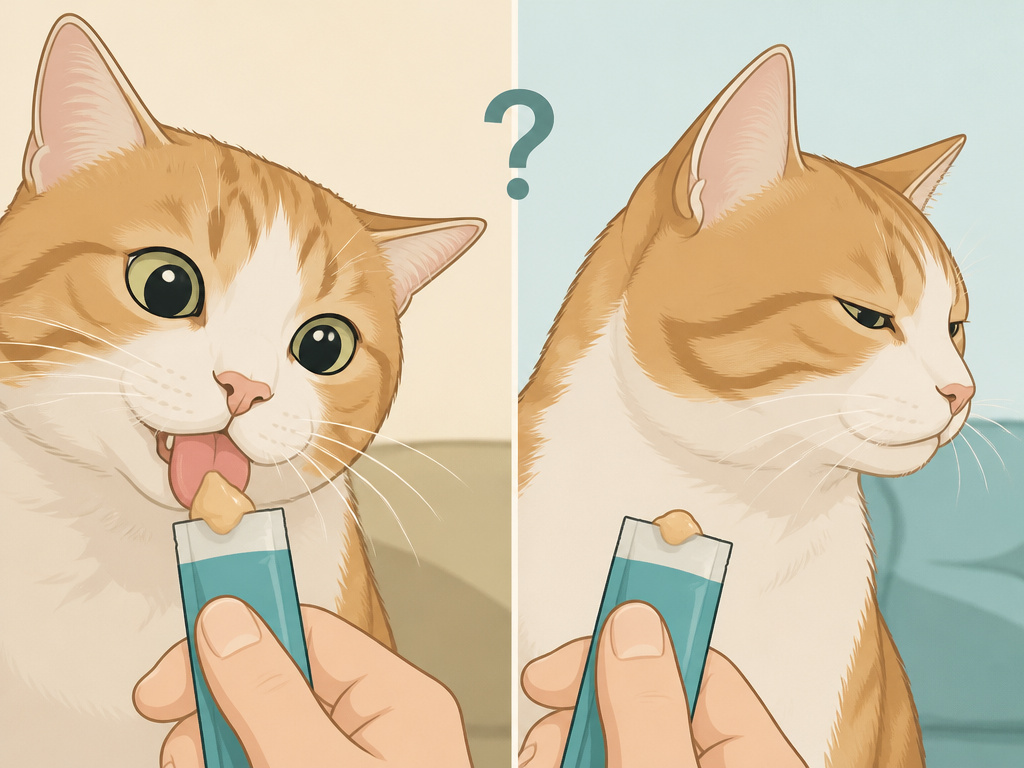
The evidence points two ways, and the split is about product class rather than cat preference.
Vet Med (Czech) 2012 tested a liquid nutritional supplement across 60 cats and 60 dogs of different ages and breeds. The supplement was highly palatable, with a clear preference over water at all dilutions. That’s a strong result from a controlled trial.
JAVMA 2023 tested something different: liquid compounding flavors, 211 oil-based samples and 311 water-based. It found 58.8% (124/211) of the oil-based flavors and 84.5% (267/311) of the water-based flavors were rejected or only minimally accepted. Sweet water-based flavors were the least accepted, at P<.001 against savory.
Both findings are real. They describe different products. A nutritional supplement formulated for palatability isn’t the same thing as a compounding flavor base.
I won’t tell anyone their cat will like a liquid treat because the cat liked a different one. The JAVMA oil-based flavor compounding study measured how badly owners predict this, and the answer is very badly.
That prediction number is worth sitting with. Owners were not able to accurately predict which flavors their cats would accept, at a Kendall tau of -0.466.
This is the one place where consumer advice and trial data genuinely part company. PetMD’s veterinary panel recommends looking for the flavor your cat likes best, which is sensible for a cat with a known history. The trial data says that preference won’t transfer to an unfamiliar liquid. For cats with a track record of rejecting new formats, treats for picky cats is the narrower problem to solve first.
Where Liquid Treats Go Wrong: Portion and the Meal Swap
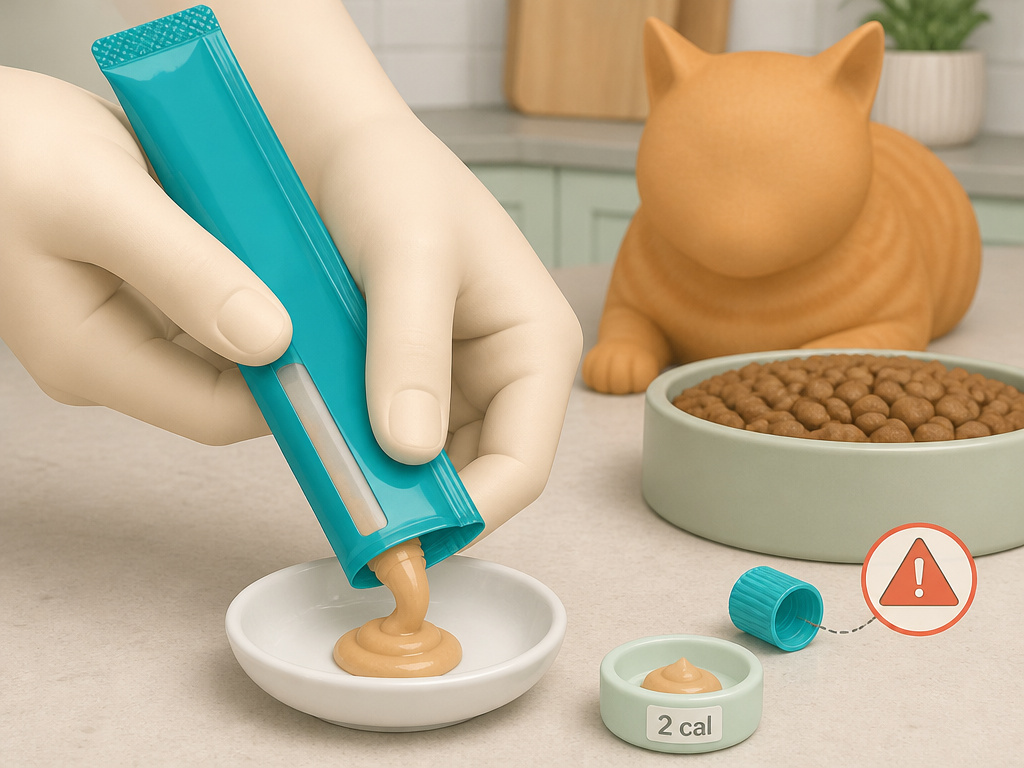
Portion control is where the format fails in practice, and the failure is usually structural rather than greedy.
WSAVA states plainly that treats should never replace a meal, and that every cat needs a complete and balanced diet. Vet Med (Czech) 2012 goes further in the same direction: if a liquid nutritional supplement is used as a single food, deficiencies and malnutrition may occur.
VCA Animal Hospitals adds the behavioural layer. Too many treats can interfere with a cat’s appetite for regular food, which is how a cat ends up holding out for the tube at dinner.
The label doesn’t rescue you either. VCA notes that treats labelled “light” or “lower calorie” are not significantly lower in calories than other treats, and they still add to the daily total.
Before you start: Tube caps and torn pouch corners come off in a cat’s mouth, and WSAVA flags treat size and shape as a choking risk, so hold the tube rather than letting the cat chew it loose. Unprocessed raw liquid treats carry a pathogen-transmission risk to the cat and to the people handling the package. Supervision covers both.
For an overweight cat, PetMD’s veterinary panel suggests a treat at around 2 calories or less per treat. That’s a genuinely useful threshold, and it’s hard to hit with a product dosed by volume.
Against that baseline, the difference between a 2-calorie reward and a half-tube is the whole game.
Why “Just a Few” Is the Number That Matters
Nobody measures a squirt. That’s the honest problem with the format, and it’s worse than it is with kibble-shaped treats because there’s no piece count to keep.
The fix is unglamorous. Portion the day’s allowance into a small dish in the morning and draw from it. When the dish is empty, the treats are done.
If you want formats that make the counting easier, the healthy cat treats comparison sorts options by whether a per-piece calorie figure is published at all.
Which Cats Should Skip Liquid Treats Entirely
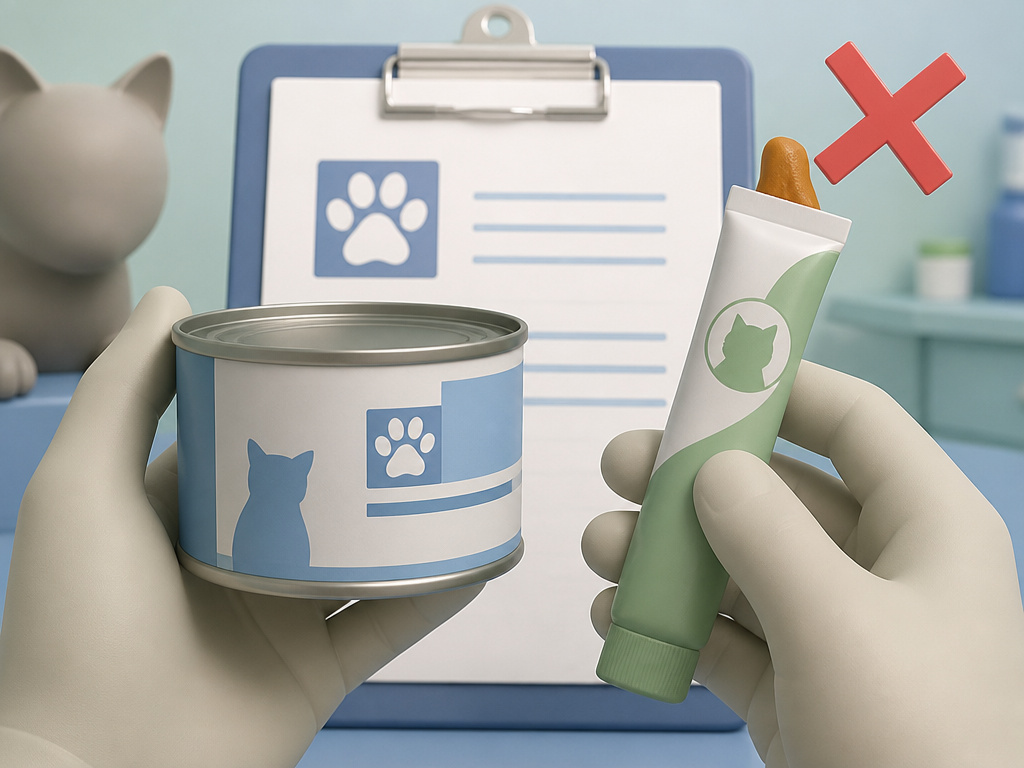
Some cats shouldn’t get liquid treats at all, and the reason usually sits on a prescription label rather than a marketing one.
WSAVA is direct about this. If a cat has a medical condition, dietary sensitivities, or is on a veterinary-prescribed diet, conventional treats may not be appropriate, and the veterinary healthcare team should be asked what is suitable.
VCA explains the mechanism for one common case. Some veterinary diets may not work properly if additional food items and treats are fed, with prescription urinary foods named specifically. A therapeutic diet is formulated to a target, and extra food moves the cat off that target.
The rule that follows is simple: with a special diet, stick to treats the veterinarian deems safe alongside that food, though the 2025 authors note that cutting food intake to make room for treats may not be ideal for neutered and indoor cats. VCA also suggests asking whether a canned version of the prescribed diet can be baked into small treats, which keeps the formulation intact.
Prescription Diets and the Treat That Undoes Them
This is the section where I have to be careful about my own limits. I read formulations for a living, and I can tell you what a guaranteed analysis says. I can’t tell you whether your cat’s urinary diet has room for a squeeze tube, because that depends on the diagnosis and the diet’s buffering.
Ask the vet who prescribed it. That’s not a dodge. It’s the only answer that’s actually correct.
The raw question is separate, and the sources split on it: WSAVA and VCA flag raw and freeze-dried raw treats as a pathogen/bacterial risk, while some popular advice calls single-ingredient freeze-dried meat the gold standard. WSAVA lists unprocessed, raw animal-based treats as a pathogen-transmission risk. VCA advises wariness of freeze-dried or dehydrated raw treats specifically, because the bacterial contamination risk extends to the cat, to other pets, and to humans through saliva and feces.
That runs against a lot of popular advice calling single-ingredient freeze-dried meat the gold standard. The anecdotal palatability case for it is real. The safety case from both WSAVA and VCA points the other way, and on a food-safety question the veterinary bodies win. If you want the additive-free angle without the raw risk, natural cat treats without artificial ingredients is the safer place to start.
There’s a second group the standard advice underserves. The 2025 Vet. Sci. Authors conclude that reducing food intake to accommodate treats may not be ideal, particularly for neutered and indoor cats. For a sedentary indoor cat on a tight calorie budget, the 10% ceiling is still a ceiling, and the 2025 authors note that cutting food to make room for treats may not be ideal for neutered and indoor cats.
Do Health-Claim Liquid Treats Deliver?
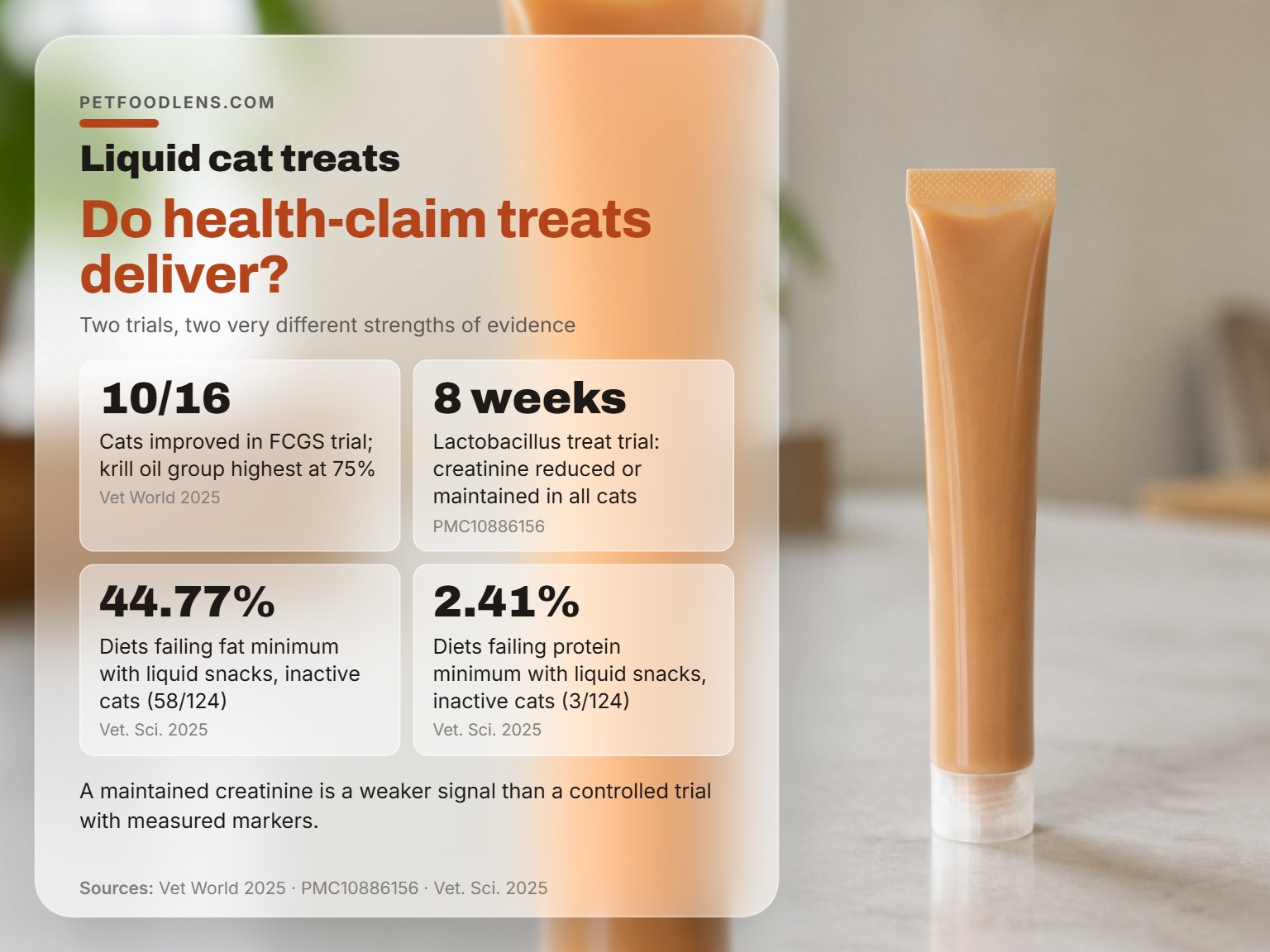
Two clinical trials say something about functional treats, and they don’t say the same thing.
The first is an 8-week Lactobacillus mixture treat trial in cats with chronic kidney disease, published through PMC. Creatinine was reduced or maintained in all cats over the 8-week administration window.
The second is a 2025 RCT in feline chronic gingivostomatitis. Owners reported improvement in 10 of 16 cats, with the krill oil group highest at 75%. There were no statistically significant cytokine changes.
Both are real results. The strength of evidence is not comparable. A finding that creatinine was maintained or reduced is a weaker signal than a controlled comparison with measured inflammatory markers, and the FCGS trial’s own authors describe only mild clinical benefit.
Common mistake: Reading “supports kidney health” on a pouch and treating it as the same claim as a therapeutic diet. WSAVA’s guidance is that conventional treats may not be appropriate for a cat on a prescribed diet, and a maintenance claim doesn’t change that.
There’s a measurement problem underneath all of this. A PMC analysis of pet food and treat nutrients examined nutrient and Maillard reaction product concentrations across commercial products, and the broader lesson from that line of work is that what’s printed on a guaranteed analysis and what’s measured in the finished product are two different numbers.
If you’re going to spend on a functional treat, spend on one where the claim traces to a trial. The probiotic pet treats feline kidney disease study is the kind of document to ask a manufacturer for. Ask a manufacturer for the trial behind a functional claim.
How to Read a Liquid Treat Label in 30 Seconds
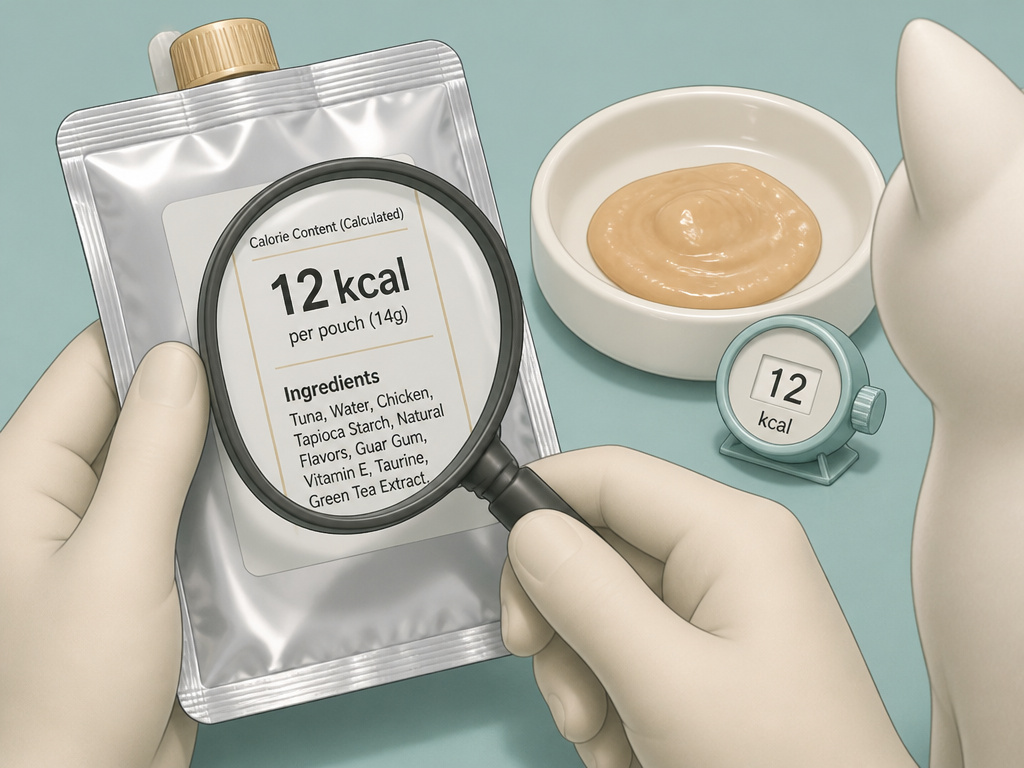
Three questions settle most of it: what’s the first ingredient, what’s the calorie figure per unit, and is there a named animal protein.
Work through them in this order:
- Flip the pouch and find the calorie statement. If there’s no kcal figure, WSAVA says to contact the manufacturer. If there’s no kcal figure, WSAVA says to contact the manufacturer.
- Check the first ingredient for a named meat. “Chicken” or “salmon” is a starting point. “Meat by-products” or a starch is a different product wearing the same pouch.
- Look for added sugar or artificial dye. None of these belong in a cat treat, and they show up in cheap tubes more often than the front label admits.
- Check for artificial color. Artificial color is for the person holding the tube, not the cat. The dye is for the person holding the tube.
- Compare the calorie figure against your cat’s ceiling. A 4 kg cat has 22 kcal to spend. Do the division before you open it.
That’s the whole audit. It takes less time than reading the front of the bag.
For the format question specifically, choose a crunchy option with a published calorie figure, and check whether a dental treat carries the Veterinary Oral Health Council seal. If a dental claim matters to you, the Veterinary Oral Health Council seal is what certifies that the plaque or tartar claim was actually tested, per PetMD’s panel. Buy the seal, not the shape.
The best cat treats comparison and the lickable cat treats roundup both sort by whether a per-unit calorie figure is published, which is the only filter that matters at the shelf.
Frequently Asked Questions
Can liquid treats replace water for a cat that drinks very little?
No. A liquid treat is mostly fat and protein solids suspended in moisture, so it adds calories alongside fluid. A cat with low water intake needs fresh water, wet food, or a fountain, not a snack tube. Using treats as a hydration strategy usually overshoots the calorie allowance before it makes a meaningful difference to fluid balance.
Are lickable treats safe for cats with kidney disease or diabetes?
Ask the vet managing the condition before introducing any tube or pouch. Both conditions put a premium on controlled phosphorus, protein quality, and carbohydrate load, and these products vary widely in all three. The label alone rarely gives enough detail, so the manufacturer’s full nutrient profile is the better document to bring to the appointment.
How many squeeze tubes can a cat have in a day?
Work backward from the 10% treat ceiling rather than counting tubes. Divide the treat allowance by the tube’s stated calorie content, and remember that a tube used to deliver a pill counts against the same total. For a typical inactive adult cat the number is often smaller than owners expect, sometimes one tube or less.
Do liquid treats help a picky cat gain weight?
They can add calories a reluctant cat will actually accept, which is their strongest practical use. The catch is that fat shortfall is the format’s known weak point, so a cat relying on them heavily may still miss fat-soluble nutrient minimums. Use them as a short-term bridge and confirm the overall diet meets requirements rather than assuming the treat covers the gap.
The Bottom Line
Here’s the threshold I’d actually use. If your cat is neutered, indoor, or carrying extra weight, keep the 10% ceiling in mind but note the 2025 authors’ caution that cutting food to make room for treats may not be ideal for exactly that group. The 2025 authors say cutting food to make room for treats may not be ideal for exactly that group, and 61% of pet cats are already overweight or obese.
The first step this week is small and boring: put the day’s treat allowance in a dish in the morning. Whatever’s in the dish is what the cat gets. A liquid tube makes that harder because there’s no piece count, so measure the first one into the dish and see how much of the allowance it eats.
One concession worth stating plainly. If your cat is on a prescription diet, none of the calorie math above settles anything. The prescribed diet has a target, VCA notes that added food can stop it working, and the only person who can tell you whether a tube fits is the vet who wrote the prescription.
