
7 Best Low Sodium Dog Food in 2026
This post contains affiliate links. As an Amazon Associate, we earn from qualifying purchases.
The best low sodium dog food for dogs with diagnosed heart conditions is Hill’s Prescription Diet h/d Heart Care Dry Dog Food, thanks to its targeted cardiac nutrients and reduced sodium levels. For early cardiac support, Royal Canin Veterinary Early Cardiac offers moderate sodium restriction with omega-3s. Owners wanting an over-the-counter option should consider Kidney Restore Non-Prescription Wet Dog Food.
Reading a dog food label for sodium content is different from looking at protein or fat. Many commercial foods contain added salt for palatability, and a “low sodium” claim on the front of the bag doesn’t always match the fine print on the back. Your veterinarian should guide any sodium-restricted diet, as the right level depends on your dog’s specific condition.
This guide evaluates seven low sodium dog foods based on manufacturer specifications, veterinary nutrition guidelines, and patterns in owner feedback. We break down what sodium levels actually mean, which conditions require restriction, and how to match a food to your dog’s specific health needs.
Top 7 Low Sodium Dog Foods in the Market
Certain content that appears on this site comes from Amazon. This content is provided "as is" and is subject to change or removal at any time.
The Best Low Sodium Dog Foods, Reviewed
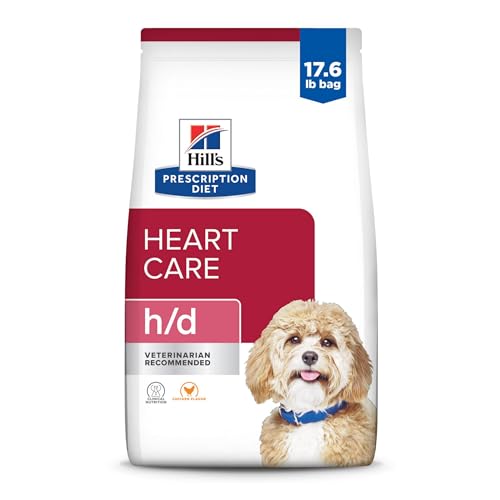
Hill's Prescription Diet h/d Heart Care Dry Dog Food
What We Like
- High L-carnitine & taurine for heart
- Reduced sodium for blood pressure
- Added potassium & magnesium support
- #1 US Vet Recommended therapeutic food
Trade-offs
- Requires veterinary prescription to purchase
- Not a general low-sodium diet for healthy dogs
Reduced sodium, plus high levels of L-carnitine and taurine, make this a targeted support for dogs with heart concerns. The formulation aims to maintain normal blood pressure and minimize fluid retention, which is exactly what a dog with cardiac issues needs. It also replenishes nutrients lost with diuretics, adding potassium and magnesium. This specific design suits dogs whose vet has already flagged heart health, not just any dog on a low-sodium kick.
The trade-off is that this is a prescription food, so you cannot just grab it off the shelf. That limits its use to dogs under veterinary care for heart conditions. If your dog has a confirmed heart issue, the prescription requirement is a minor hurdle for a diet built around that specific need. If you just want a low-sodium option for a healthy dog, look elsewhere.
Product photos
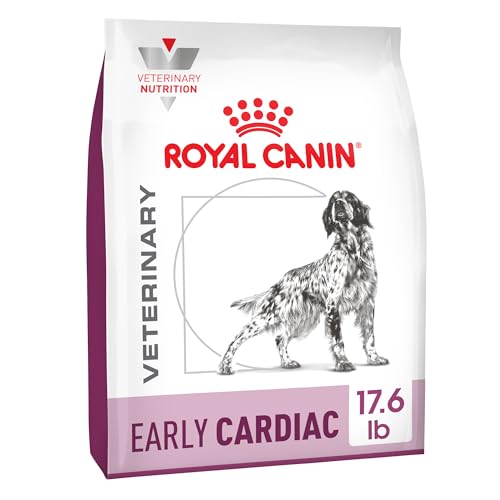
Royal Canin Veterinary Early Cardiac Dry Dog Food
What We Like
- Moderate sodium restriction reduces heart workload
- Contains EPA & DHA omega-3s for heart health
- Includes arginine, carnitine, and taurine
- Highly digestible and palatable formula
Trade-offs
- Moderate sodium level still higher than severe restriction
- Targets cardiac health, not general low-sodium needs
- Prescription diet requires veterinary authorization
Moderate sodium restriction, not severe, not free, means this food reduces the heart’s workload while still providing enough sodium for palatability and normal function. That balance is the whole point: dogs with early cardiac disease need support, not starvation of a critical mineral. The added EPA and DHA omega-3s directly support cardiovascular function, while arginine, carnitine, and taurine round out the cardiac nutrient profile. This is a targeted tool for dogs already diagnosed or at known risk, not a general low-sodium maintenance diet.
The moderate sodium restriction in this food reduces the workload on a dog’s heart, which is a key goal in managing early cardiac issues, but it won’t be enough for dogs needing severe sodium limits. The formula includes arginine, carnitine, and taurine to support optimal cardiac health, along with EPA and DHA omega-3s for cardiovascular function. It’s a complete and balanced diet developed by veterinarians, so you’re getting a targeted nutrient profile without extreme salt reduction.
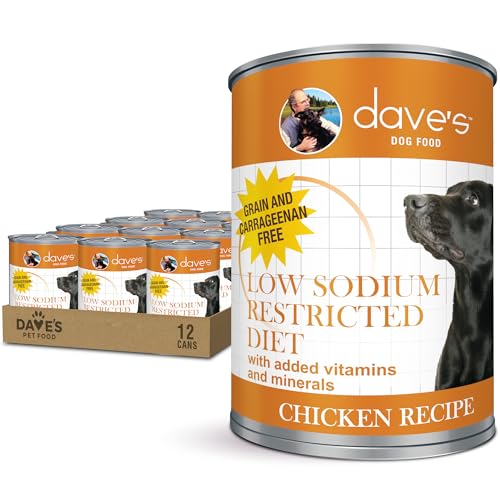
Dave's Pet Food Restricted Sodium Diet Canned Dog Food
What We Like
- Chicken is #1 ingredient
- Low sodium for vet-recommended diets
- Added vitamins and minerals
Trade-offs
- Canned food has shorter shelf life after opening
- Only one protein option (chicken pate)
A 13.2-ounce can of chicken pate that lists chicken as the first ingredient is the kind of straightforward protein sourcing I like to see. This is a low-sodium wet food formulated for dogs whose vet has recommended cutting back on salt, and it includes added vitamins and minerals. For a canned option, it delivers a clean recipe with added vitamins and minerals, and it’s made in the USA. If you’re looking for a way to manage your dog’s sodium intake without wading through a long list of additives, this fits the bill.
Chicken is the #1 ingredient in this canned dog food, so it delivers protein for strong, lean muscles. The downside is that you’re limited to chicken pate, so if your dog needs variety or has poultry sensitivities, this won’t stretch far. Compared to Hill’s Prescription Diet h/d Heart Care, a dry kibble for heart care, Dave’s is a wet food that’s an excellent choice when a vet has recommended a low-sodium diet. That makes it a practical option for owners who want a low-sodium canned food, but it’s not a replacement for a prescription diet if your vet has flagged a heart issue.
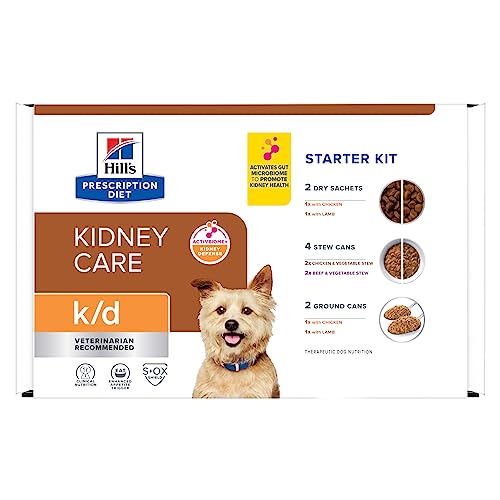
Hill's Prescription Diet k/d Kidney Care Variety Pack
What We Like
- Reduced sodium and phosphorus for kidney health
- Includes prebiotic blend ActivBiome+ Kidney Defense
- Clinically tested appetite trigger (E.A.T.)
- Variety of flavors and textures to try
Trade-offs
- Prescription required, not an over-the-counter option
- Only a starter kit, not a full-size bag or case
- Designed for kidney care, not general low-sodium needs
A 3.7-pound variety pack with reduced sodium and phosphorus means this kit is built to support kidney function while letting you test different textures and flavors before committing to a full bag or case. The ActivBiome+ Kidney Defense prebiotic blend targets the gut microbiome, and the E.A.T. technology is clinically tested to stimulate appetite in dogs that might be picky due to illness. For owners whose vet has recommended a renal diet, this starter pack offers a practical way to see what your dog will actually eat without buying multiple large bags first.
The drawback here is that this is a prescription product, so you cannot just grab it off the shelf, you need a vet’s okay. That limits its use for someone simply looking for a low-sodium maintenance food. Compared to Dave’s Pet Food Restricted Sodium Diet, which is available without a prescription, this Hill’s kit requires a consultation and is tailored specifically for dogs with diagnosed kidney issues. That makes it a targeted tool rather than a general low-sodium option, but for the right dog, the variety and clinical backing are hard to beat.
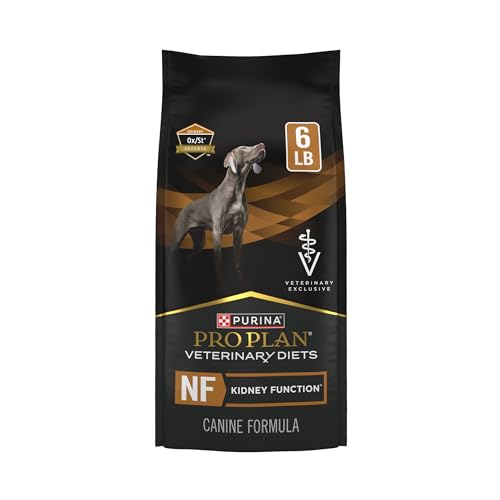
Purina Pro Plan Vet Diets NF Kidney Function Dry Dog Food
What We Like
- Restricted phosphorus for kidney support
- Reduced sodium helps manage kidney conditions
- Energy-dense formula for needed calories
- Contains antioxidants for adult dogs
Trade-offs
- Only available in a 6 lb bag size
- Not suitable for dogs with heart conditions
A restricted phosphorus level is the headline here, this kibble is designed to take the load off failing kidneys by limiting what those organs have to filter. The reduced sodium follows the same logic, and the energy-dense formula means a smaller portion still delivers the calories a dog with kidney disease needs. That combination makes it a targeted option for dogs whose lab work shows elevated kidney values, not a general-purpose low-sodium food. The antioxidants are a nice addition for overall immune support in an older or compromised dog.
Restricted protein isn’t ideal for every dog, if yours is still active or young, this formula might leave them short on building blocks for muscle maintenance. Compared to Hill’s Prescription Diet k/d Kidney Care Variety Pack, which offers both dry and wet formats, this Purina bag is strictly dry and comes in a single 6 lb size. That works for a small dog or a trial run, but a larger breed will burn through it fast. It’s a prescription diet, so you’ll need a vet’s okay, but that’s par for the course when you’re managing kidney function.
Product photos
SquarePet VFS Low Phosphorus Dog Food Canned

What We Like
- Low phosphorus and sodium
- Veterinary nutritionist formulated
- USA-sourced beef and beef liver
- Omega-3 fatty acids DHA & EPA
Trade-offs
- Wet food only, not a dry kibble
- Canned format means more waste per serving
For dogs that need tight control over phosphorus and sodium, this canned formula delivers those numbers in a straightforward beef-based recipe, taking the guesswork out of managing a restricted diet. Developed by board-certified veterinary nutritionists, the nutrient profile is built around specific dietary needs. DHA and EPA omega-3s support overall health, while vitamins C and E help with oxidative stress.
This food comes only as a wet product, which means more packaging waste and a shorter shelf life once opened compared to dry kibble. For a dog with specific kidney needs, the low phosphorus and sodium are the priority, and the canned texture can be easier to eat for dogs with reduced appetite. Just be prepared to store opened cans in the fridge and use them quickly.
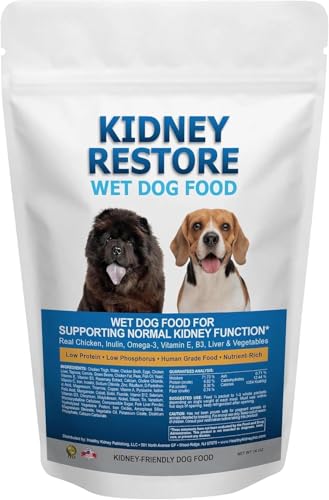
Kidney Restore Non-Prescription Wet Dog Food
What We Like
- Low sodium and low phosphorus levels
- Made in USA
Trade-offs
- Wet food spoils quickly once opened
- Not suitable for dogs without kidney issues
Because it’s a wet food, it’s not as convenient for leaving out all day like a dry kibble such as Hill’s Prescription Diet h/d Heart Care. If you need something that stays fresh without refrigeration, that dry option might be a better fit. But if you want a no-prescription low sodium wet food, this one is straightforward and gets the job done.
Product photos
How We Evaluated Low Sodium Dog Foods
Our evaluation started with the hard numbers: guaranteed analysis for sodium content, phosphorus levels, and caloric density from manufacturer documentation. We cross-referenced these against veterinary guidelines for cardiac and renal diets, noting where each product falls on the spectrum from moderate to severe sodium restriction. Owner feedback patterns helped us understand palatability and stool quality, since a nutritionally perfect food does no good if a dog refuses to eat it.
We prioritized four criteria. First, sodium level relative to the dog’s condition, a food suitable for early heart disease may still be too high for advanced kidney failure. Second, supporting nutrients like taurine, L-carnitine, and omega-3 fatty acids that address the underlying organ stress. Third, protein quality and phosphorus content, since many dogs needing low sodium also have compromised kidneys. Fourth, accessibility, whether the food requires a prescription or is available over the counter.
A research-led evaluation has limits. We did not feed these foods to dogs in a controlled trial, and individual responses vary. A dog’s specific sodium tolerance depends on their diagnosis, stage of disease, and concurrent medications. Always share any diet change with your veterinarian, especially when managing a chronic condition.
What To Look For In Low Sodium Dog Foods
Choosing a low sodium dog food means matching the sodium restriction level to your dog’s specific medical diagnosis. Heart disease, kidney disease, and hypertension each require different sodium targets and supporting nutrients.
Look for a sodium level (dry matter basis) below a moderate restriction threshold and below a severe restriction threshold. Check phosphorus if your dog also has kidney issues. Prioritize foods with added taurine and L-carnitine for cardiac support.
Sodium Level and Your Dog’s Condition
The appropriate sodium level depends entirely on your dog’s diagnosis. For dogs with early heart disease, moderate sodium restriction on a dry matter basis is typical. Dogs with congestive heart failure or advanced kidney disease often need severe restriction. A food labeled “low sodium” for one condition may be dangerously high for another. Always get a specific sodium target from your veterinarian.
Supporting Nutrients for the Affected Organ
Low sodium alone isn’t enough. Dogs with heart conditions benefit from added taurine, L-carnitine, and omega-3 fatty acids like EPA and DHA, which support cardiac muscle function and reduce inflammation. Dogs with kidney disease need restricted phosphorus alongside reduced sodium, plus antioxidants and B vitamins to manage oxidative stress. Look for these additions in the guaranteed analysis or ingredient list.
Prescription vs. Over-the-Counter
Many effective low sodium diets require a veterinary prescription because they are formulated as therapeutic foods for specific diseases. These diets offer precise nutrient profiles that over-the-counter foods cannot legally match. Over-the-counter low sodium options exist but typically offer milder restriction and fewer targeted nutrients. Your veterinarian can tell you whether a prescription diet is necessary for your dog’s stage of disease.
- Confirm your dog’s target sodium level with your vet before shopping
- Check phosphorus if your dog has kidney concerns, look for levels below a certain dry matter threshold
- Verify the food includes cardiac-support nutrients like taurine and L-carnitine for heart conditions
- Ask whether a prescription diet is recommended before buying over-the-counter
A dog with heart disease needs a different nutrient profile than a dog with kidney disease, even when both need low sodium.
Low Sodium Dog Foods Compared
The table below compares all seven low sodium dog foods across key specifications to help you match a diet to your dog’s specific health needs.
| Product | Sodium Claim | Form | Weight |
|---|---|---|---|
| Hill's Prescription Diet h/d Heart Care Dry Dog Food | Reduced | Dry | 17.6 lb |
| Royal Canin Veterinary Early Cardiac Dry Dog Food | Moderate | Dry | 17.6 lb |
| Dave's Pet Food Restricted Sodium Diet Canned Dog Food | Low Sodium | Canned Pate | 13.2 oz, 12-pack |
| Hill's Prescription Diet k/d Kidney Care Variety Pack | Low Sodium | Variety Pack | 3.7 pounds |
| Purina Pro Plan Vet Diets NF Kidney Function Dry Dog Food | Reduced | Dry | 6.0 pounds |
| SquarePet VFS Low Phosphorus Dog Food Canned | Low | Canned | 13oz Cans, Case of 12 |
| Kidney Restore Non-Prescription Wet Dog Food | Low Sodium | Wet Dog Food | 16 Ounce |
Frequently Asked Questions
What is considered low sodium in dog food?
Low sodium dog food typically contains less than a moderate restriction sodium level on a dry matter basis, and below a severe restriction level. For comparison, many standard commercial dog foods contain higher sodium levels. Always check the guaranteed analysis and convert to dry matter basis for accurate comparison across wet and dry foods.
Can I feed my dog low sodium food without a prescription?
Yes, over-the-counter low sodium options exist, such as Kidney Restore Non-Prescription Wet Dog Food. However, these foods typically offer milder sodium restriction and fewer targeted cardiac or renal nutrients than prescription therapeutic diets. A veterinary prescription diet may be necessary for dogs with advanced heart or kidney disease.
Is low sodium dog food the same as kidney diet food?
No, not exactly. Kidney diets restrict both sodium and phosphorus, while heart diets focus primarily on sodium reduction and include cardiac-support nutrients like taurine and L-carnitine. Some foods overlap, but you should match the nutrient profile to your dog’s specific diagnosis. A dog with kidney disease needs low phosphorus; a dog with heart disease needs cardiac amino acids.
How do I transition my dog to a low sodium diet?
Transition gradually over several days by mixing increasing amounts of the new food with the old food. Sudden changes can cause digestive upset. Monitor your dog’s appetite, energy level, and any changes in thirst or urination. Report any concerns to your veterinarian, especially if your dog is on heart or kidney medication that interacts with diet.
What treats can I give a dog on a low sodium diet?
Many commercial dog treats are high in sodium and should be avoided. Look for low sodium treats specifically formulated for restricted diets, or offer small pieces of plain cooked chicken, green beans, or carrots. Avoid cheese, deli meats, and commercial biscuits that list salt or sodium among the first ingredients.
The Bottom Line
For dogs with diagnosed heart conditions requiring veterinary supervision, Hill’s Prescription Diet h/d Heart Care Dry Dog Food is the best overall choice. Its precise sodium restriction, high levels of L-carnitine and taurine, and added potassium and magnesium make it the most complete cardiac diet on our list. It requires a prescription, which is appropriate for the dogs it serves.
If your dog has early cardiac disease or you need a more affordable option, consider Royal Canin Veterinary Early Cardiac for moderate sodium control with omega-3 support. Dave’s Pet Food Restricted Sodium Diet Canned Dog Food is a budget-friendly, over-the-counter wet food. For dogs with kidney disease, Purina Pro Plan Vet Diets NF or the Hill’s k/d Variety Pack offer targeted low-sodium, low-phosphorus nutrition.
The single most important factor is matching the sodium restriction level to your veterinarian’s recommendation. A diet that is perfect for one condition can be harmful for another. Start with a clear sodium target from your vet, then choose a food that delivers it alongside the right supporting nutrients for your dog’s specific health needs.
