
Fish Skin Chews for Dogs Pros and Cons: Worth It?
This post contains affiliate links. As an Amazon Associate, we earn from qualifying purchases.
Fish skin chews for dogs have real pros and cons: they’re high-protein, single-ingredient treats that most dogs digest well, but they’re brittle for big chewers, weak on dental claims, and only safe as an occasional treat capped at 10% of daily calories.
That 10% ceiling is the number that decides how often a chew actually lands in the bowl. Treat budget is smaller than it looks once you count the training treats, the dental stick, and whatever the dog talks you out of at the counter, which is where the fish skin chews for dogs pros and cons question starts to matter.
What follows: the pros that survive a hard look, the cons the front of the bag leaves out, a side-by-side against rawhide, and the two places where the veterinary sources flatly disagree.
Key Takeaways
- Cap treats at 10% of daily calories. Dr. Pendergrass puts fish skin in the occasional-treat slot, not the meal slot.
- Smallbatch lists about once per week as a starting frequency, adjusted for size, diet, and how the dog responds.
- Freeze-dried is not raw. Smallbatch’s chews are freeze-dried, while Dr. Coder’s home method requires thorough cooking with no salt, oil, or seasoning.
- Large dogs get limited dental benefit. Canine Journal found fish skin too brittle to do the scraping work harder chews do.
- Avoid shark, swordfish, king mackerel, tilefish, albacore, marlin, and bluefin. Both vets flag those species for mercury and toxin load.
What Are Fish Skin Chews Actually Made Of?
Smallbatch’s Salmon and Dover Sole chews are freeze-dried fish skin, and the ingredient list stops there.
Freeze-drying removes moisture from raw fish skin under low temperature and pressure, which preserves the protein and fat structure without cooking it. The finished chew sits in the soft-to-medium texture range, with some crunch and none of the hardness of a baked biscuit or a dried bone.
The company states the chews are 100% wild-caught fish with no farmed fish, no artificial additives, and no preservatives. It puts the protein at roughly 67-68% for both the salmon and the Dover sole version.
Treat that protein figure as a brand claim. I found no independent lab verification of it in the sources I could pull, and that matters when a number is doing most of the marketing work.
Texture is where these chews split from the rest of the chew aisle, and it is central to any fish skin chews for dogs pros and cons discussion. A freeze-dried skin has a soft-to-medium give in the hand, closer to a thick potato chip than to a dried bone, and it crumbles instead of splintering.
One regulatory note worth knowing. The 2024 review in Today’s Veterinary Practice points out that minimally processed bones and body parts are not considered “food” by the FDA and are therefore poorly regulated.
Fish Skin Chews for Dogs Pros and Cons: What Actually Holds Up
Two claims survive a hard look: the protein number and the ingredient list.
- Roughly 67-68% protein in the Smallbatch salmon and Dover sole chews, per the manufacturer. That’s a high figure for a treat, and it arrives with a single ingredient.
- One ingredient, wild-caught, nothing added. No farmed fish, no preservatives, no artificial colors. For a dog with beef or chicken sensitivities, that short list is the entire appeal.
- A genuine omega-3 source. Dr. Coder describes fish skin as an excellent source of omega fatty acids, tied to hormone regulation, immunity, inflammation control, and skin and coat health.
- Palatability. In Canine Journal’s blind test, 10 out of 10 dogs chose a fish skin roll over a Milkbone biscuit.
That last point is the least scientific and the most practical. A treat the dog refuses has no nutritional value at all.
Beams Ocean Chews, made by The Honest Kitchen, took the top pick from 5 out of 10 testers in that same blind test. Each bag held between 15 and 22 chews in their count.
I judge a treat bag by what it promises and what it proves. “Single ingredient” is a claim you can check in five seconds. “Supports dental health” is a claim you cannot check at all, and it’s usually printed in the biggest font.
If you want the wider category, the best fish treats for dogs list covers the options beyond skin chews, and the omega-3 for dogs breakdown explains what the fat actually does.
The Cons the Front of the Bag Doesn’t Print
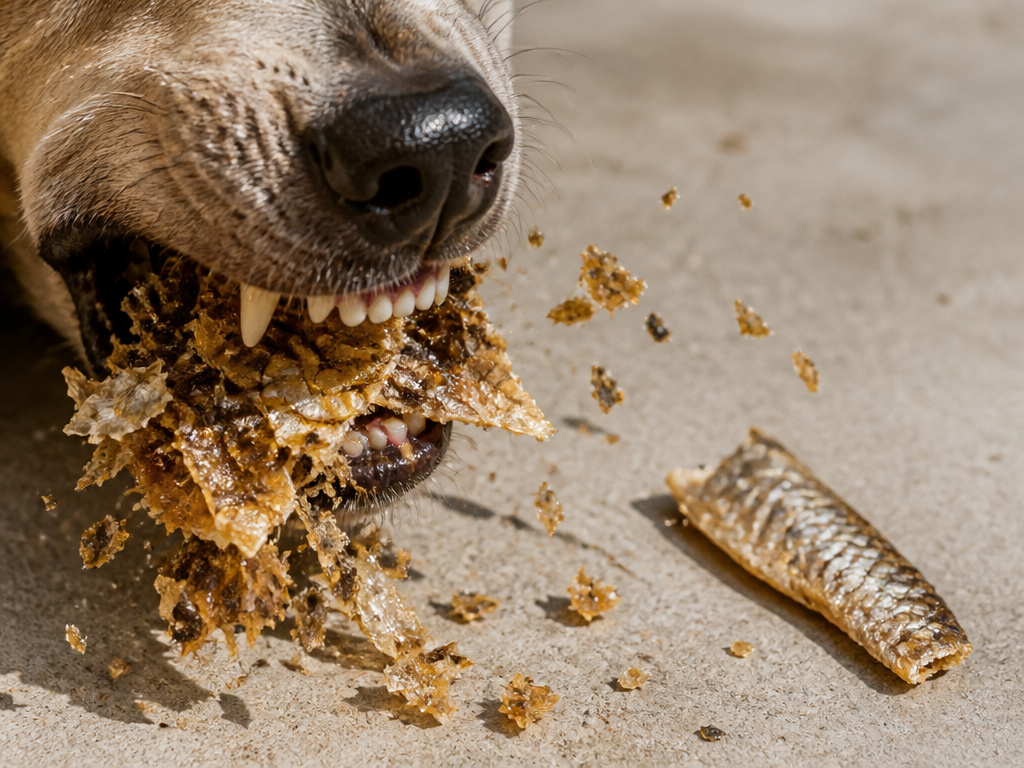
The dental claim is the softest thing on the bag.
I once read the fronts of several OTC “urinary health” cat foods in a single sitting. Roughly all of them said “supports” or “promotes.” Not one said “dissolves.” Fish skin chew bags run the same play, and “helps clean teeth” is a verb doing a lot of work.
Where the Dental Claim Falls Apart
Skipper’s markets its fish skin chews on a naturally abrasive texture that helps clean teeth and remove plaque. Canine Journal’s testers found the opposite problem. Fish skin is brittle enough that large dogs crunch it in a few bites, so it gets limited time against the tooth surface compared with harder chews.
The veterinary review adds a third position. Chews may reduce tartar and calculus, but they do not address periodontal disease, and they may cause dental injury. The same review is blunt that regular tooth brushing remains the most effective way to control tartar.
So the honest version: fish skin might knock some plaque loose on a small dog that takes a long time to finish one. A large dog that inhales it gets almost none of that. That’s the whole claim.
The Fat and Stomach Problem
Fish skin has a high fat content. Dr. Coder flags the combination of high fat and omega fatty acids as something that can change how a dog absorbs its regular diet and possibly upset the stomach.
That’s a real issue for a dog on a therapeutic or prescription diet. Dr. Pendergrass recommends a vet conversation before feeding fish skin to any dog with an underlying health issue.
Where this goes sideways: A dog on a prescription diet gets a handful of fish skin every day as a “topper.” The fat load shifts absorption, the stool loosens, and the owner blames the prescription food.
Raw, Freeze-Dried, or Home-Dehydrated: Which Is Actually Safe?
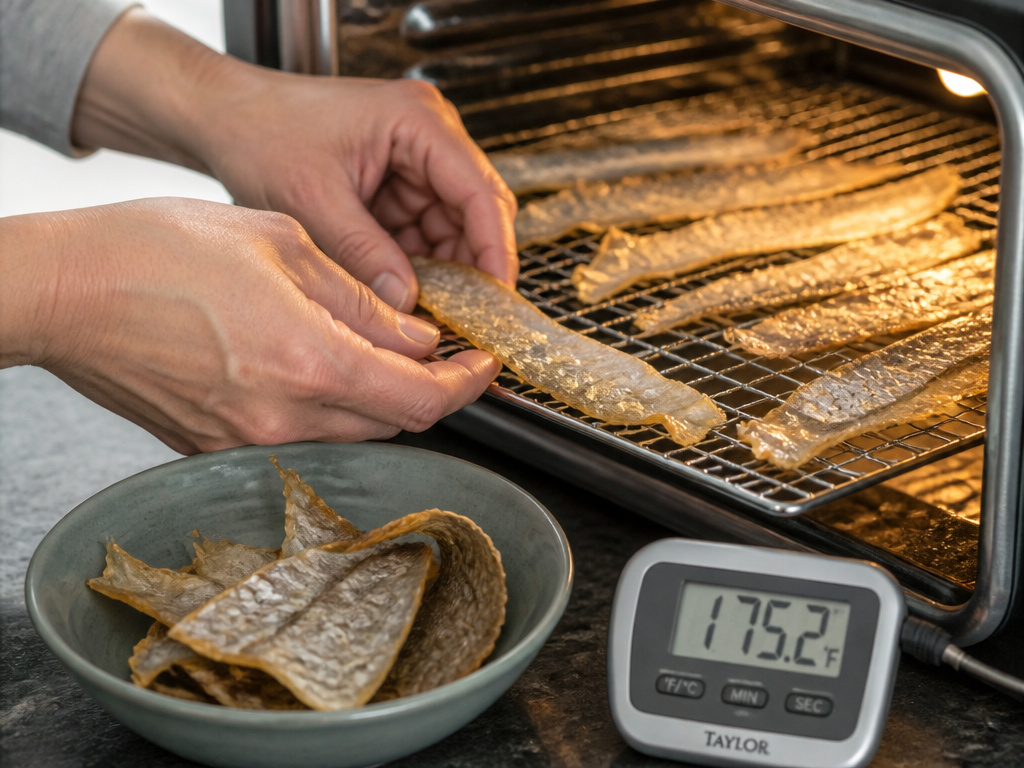
Dr. Coder’s home method and Smallbatch’s factory method start from different assumptions about heat.
Coder’s guidance for home preparation is to cook the skin thoroughly with no salt, no seasonings, and no oil, then feed it within one to two days. For dehydrating, she gives an oven range of about 150 to 200 degrees Fahrenheit for 48 hours, and notes that more attached meat and subcutaneous tissue means a longer dry.
Smallbatch’s answer is different in kind. The company states plainly that its chews are freeze-dried, which is neither raw nor dehydrated, and that the process removes moisture without heat or additives.
Both positions are defensible and they don’t reconcile. Coder’s concern is pathogen load on raw or undercooked skin. Freeze-drying is a different process from raw, and the manufacturer treats it as sufficient on its own. I’d note that no source in this set tested a freeze-dried fish skin chew for pathogens, so the disagreement stays open.
If you’re going the home route instead, the guide to making fish skin treats covers drying times and the trimming step.
Are Fish Skin Chews Safe for Puppies and Small Dogs?
Two brands answer the puppy question differently, and both answers are on the record.
The Puppy Age Disagreement
Smallbatch states its fish skin chews are appropriate for dogs of all life stages and sizes, including puppies. Skipper’s markets its fish skin sticks as suitable for dogs from 16 weeks of age.
Neither is wrong on its own terms. A 16-week floor is a conservative blanket rule for a whole product line. “All life stages” is a statement about texture and digestibility. What neither tells you is your individual puppy’s chewing style, which is the variable the ASPCA position on dog chews puts first: match the chew to the species, size, and chewing habits of the animal in front of you.
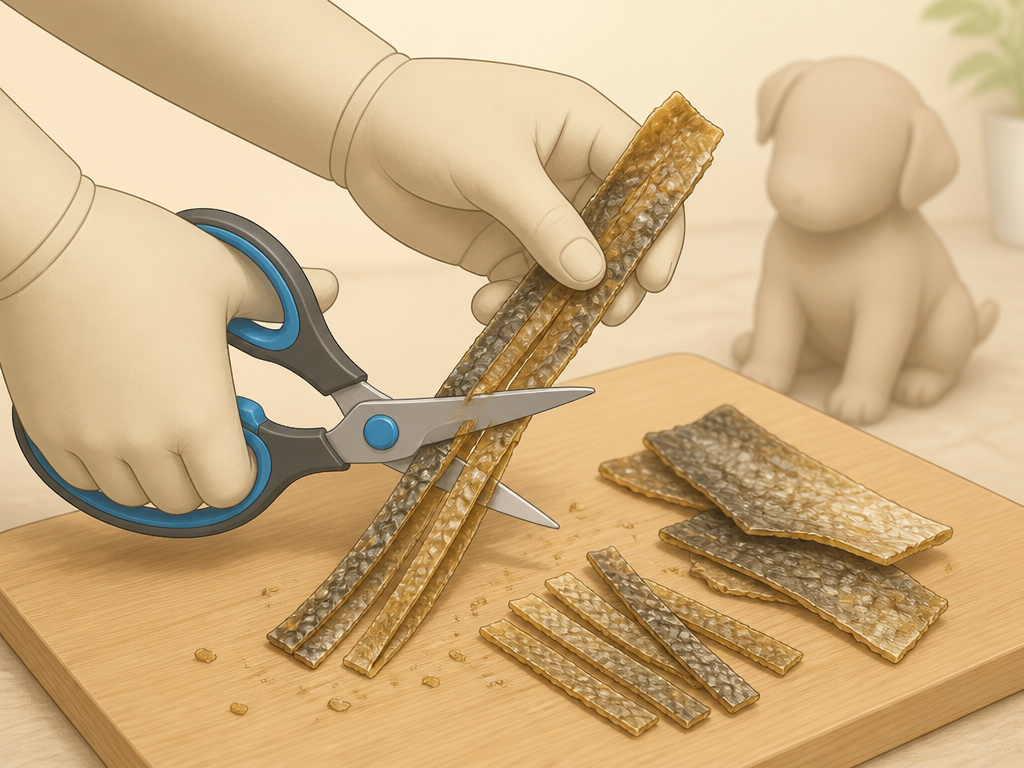
For small dogs, the practical move comes from Smallbatch itself. Cut the chew into smaller pieces with kitchen shears before offering it. That handles the size problem and portion control.
The ASPCA adds a specific warning for small dogs. Obstruction from a chew is more likely to occur in smaller dogs, and guardians should actively watch while the dog chews and call a vet immediately if a chunk goes down.
Easy to miss: Cut it lengthwise so the dog has to work at it.
Fish Skin vs Rawhide: What the Digestibility Data Actually Shows
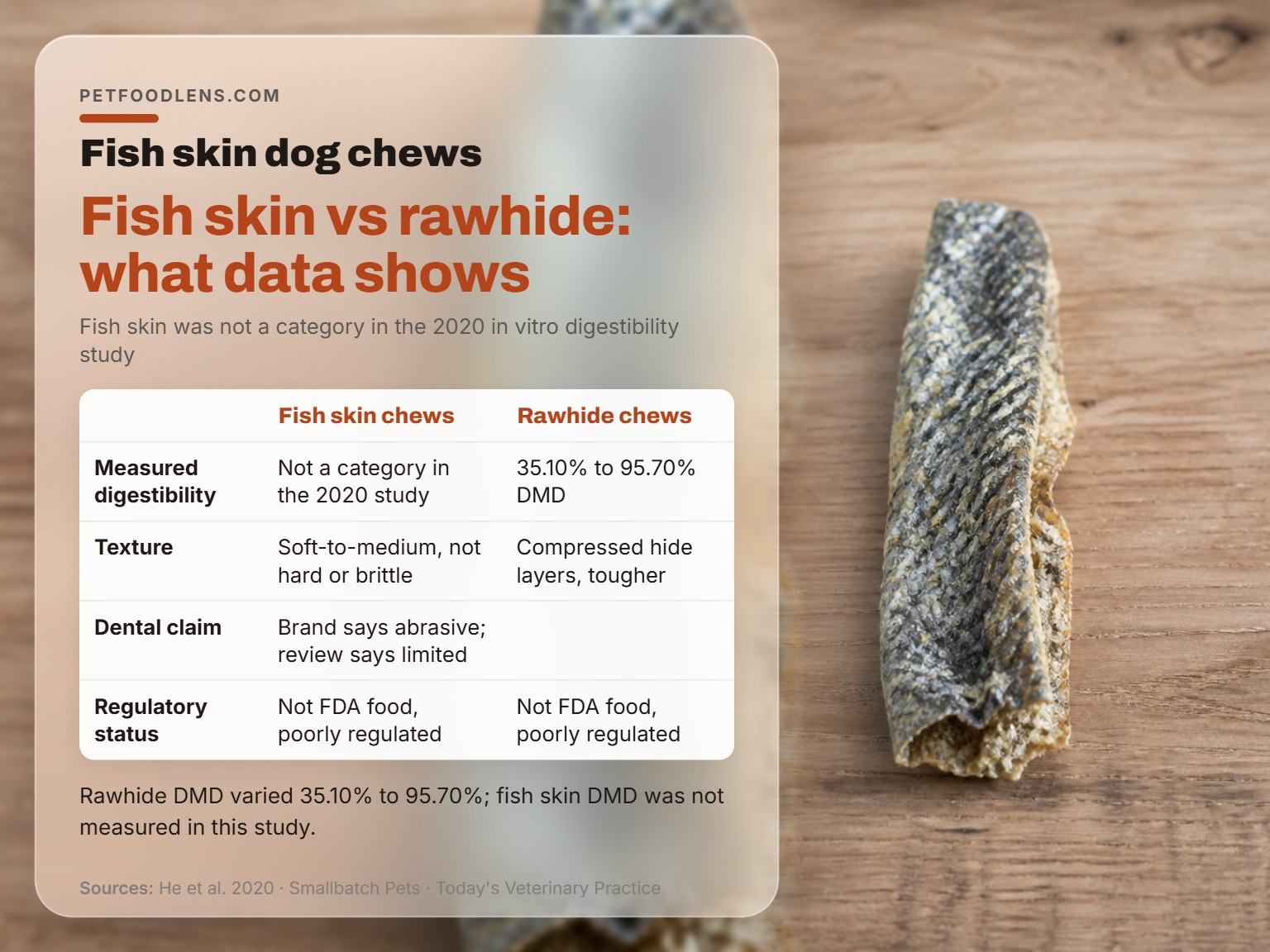
The 2020 study tested 25 commercial treats across six categories, and fish skin wasn’t one of them.
That’s the first thing to know about any digestibility comparison. The categories in the pet treat digestibility research paper were biscuit, chew, dental, meat product, rawhide, and cat treat. There is no fish-skin-specific dry matter disappearance figure in the peer-reviewed literature I could pull, so anyone quoting one is quoting a brand.
What the study does give you is a range and a warning. Across all 25 treats, dry matter disappearance ran from 8.40% to 92.20% in the gastric phase and 35.10% to 100% after the intestinal phase. Rawhide alone spanned 35.10% to 95.70%, the widest variance of any category, with gastric values from 8.41% up to 86.90%.
That spread is the point. “Rawhide” describes a process, not a digestibility rating, and two rawhide chews can behave nothing alike.
| Question | Fish skin chews | Rawhide chews |
|---|---|---|
| Measured digestibility | Not a category in the 2020 in vitro study | 35.10% to 95.70% dry matter disappearance |
| Texture | Soft-to-medium, crumbles | Compressed hide layers, tougher |
| Dental claim | Brand says abrasive; review site says limited | Abrasion claimed, tartar only per review |
| Regulatory status | Not FDA “food,” poorly regulated zone | Not FDA “food,” poorly regulated |
| Main risk | Choking on crumbles for gulpers | Swallowed leather fragments, blockage |
The study also notes that indigestible leather fragments from rawhide chews can lead to gastrointestinal blockage or diarrhea. That’s the risk profile rawhide carries and fish skin largely avoids, because fish skin crumbles between the teeth instead of forming leather strips.
That’s a texture difference. Nobody in this source set measured fish skin’s dry matter disappearance, so I won’t pretend otherwise.
The rawhide chews breakdown covers the regulatory side in more detail, and the no-hide chews comparison covers the pressed-hide alternatives if you want to avoid both. If fish skin disappears too fast for your dog, the collagen chews comparison covers a longer-lasting option.
Which Fish to Avoid, and Why the Two Vets’ Lists Differ
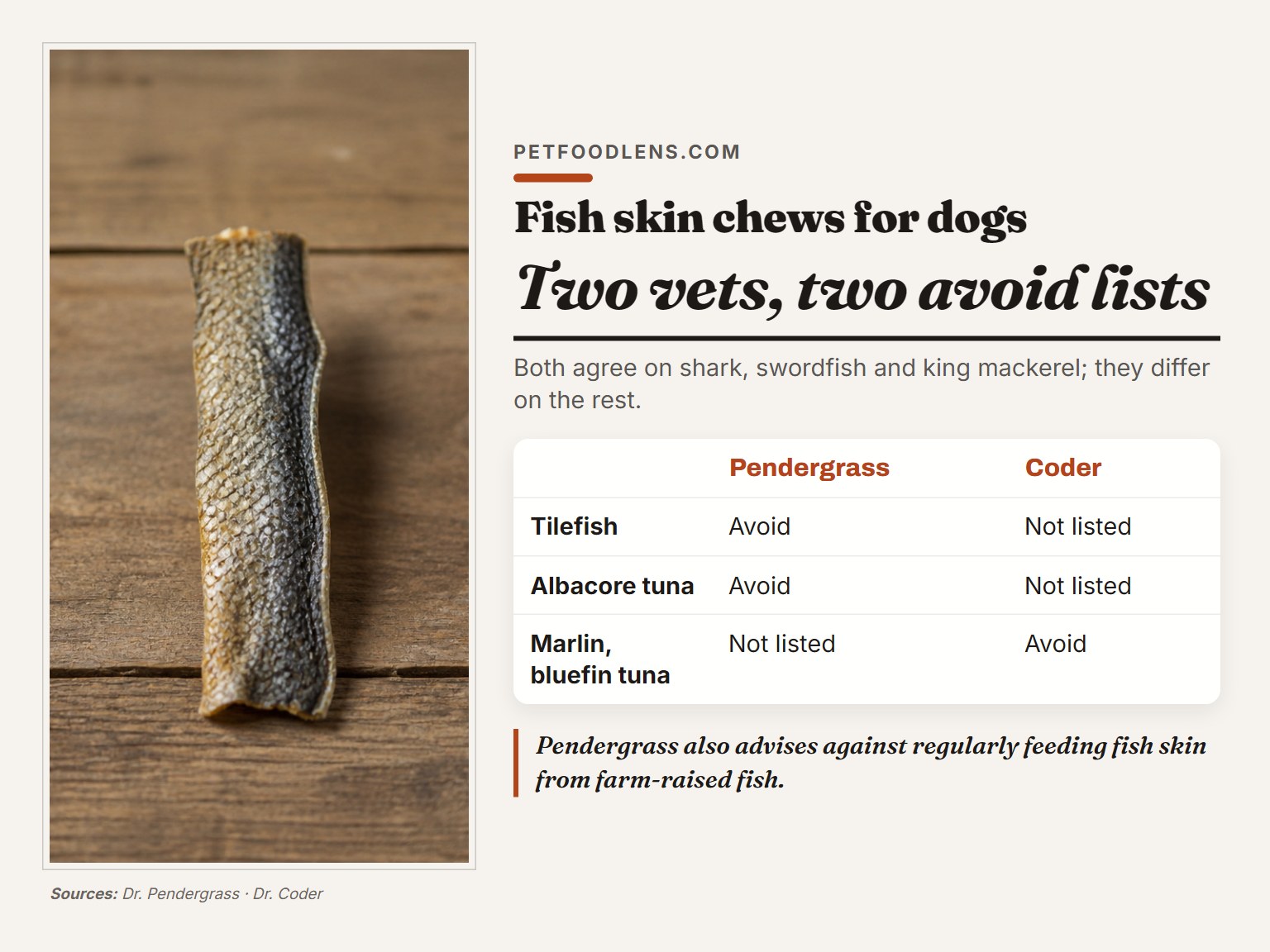
Dr. Pendergrass names five species to avoid; Dr. Coder names five, and the lists only partly overlap.
Both agree on shark, swordfish, and king mackerel. Pendergrass adds tilefish and albacore tuna. Coder adds marlin and large tuna such as bluefin, on the grounds that bigger, longer-lived fish accumulate more mercury and PCBs.
| Fish | Pendergrass (PetsRadar) | Coder (PetsRadar) |
|---|---|---|
| Salmon, whitefish, cod, catfish | Low mercury, recommended | Not addressed |
| Shark, swordfish, king mackerel | Avoid | Avoid |
| Tilefish | Avoid | Not listed |
| Albacore tuna | Avoid | Not listed |
| Marlin, bluefin tuna | Not listed | Avoid |
Pendergrass also advises against regularly feeding fish skin from farm-raised fish. Smallbatch states its chews are wild-caught only, which lines up with that advice.
For the low-mercury side, Pendergrass names salmon, whitefish, cod, and catfish. I’d shop from that list, and it happens to cover most of what’s actually sold as fish skin chews.
If you’re choosing a food rather than a treat, the fish-based dog food comparison covers the same species question at the bowl level.
How to Feed a Fish Skin Chew Without a Vet Visit
Four things decide whether the chew is a snack or an incident.
Before you start: A fish skin chew crumbles, and the crumbles are the choking risk, so stay in the room for the whole chew. Wash your hands afterward, because the fishy residue stays on skin until you do. Skip the chew entirely for a dog with a diagnosed health condition until a vet clears it.
- Match the chew to the dog, not the bag. The ASPCA’s guidance is to choose products designed for the animal’s size and chewing habits. A large dog finishes a fish skin chew in a few bites, so the chew does almost no work.
- Cut it down for small dogs. Smallbatch recommends kitchen shears for smaller dogs and cats.
- Count it inside the 10% treat ceiling. Dr. Pendergrass caps treats at 10% of daily caloric intake. Blow past that and the chew starts displacing balanced food.
- Start at about once per week. Smallbatch calls that a general starting point of about once per week, adjusted for size, diet, and response. Daily feeding is where the fat load and the loose stool show up.
- Watch the stool for the first week. Coder notes the fat and omega combination can upset the stomach. A change that shows up early is the chew, not the weather.
Sizing the Chew to the Dog
Canine Journal’s observations are the useful data point here. Larger dogs finished fish skin chews in almost no time.
For rapid consumption of a chew, the ASPCA’s warning is the one that matters. Rapid consumption of a chew can lead to intestinal obstruction and perforation requiring immediate surgical intervention.
Two housekeeping items. Canine Journal recommends removing any cartilage or bone still attached to the skin before feeding, because natural products vary and pieces do turn up. For storage, an airtight container in a cool, dry spot keeps most fish skin chews for at least 6 months.
And the smell. Fish skin chews carry a strong fishy aroma that stays on your hands after handling, which is the price of a single-ingredient product.
Frequently Asked Questions
How often can a dog have a fish skin chew?
Smallbatch suggests about once per week as a general starting point, then adjust for size, diet, and response. Dr. Pendergrass frames the same idea from the calorie side: treats should make up no more than 10% of daily caloric intake. Those two rules work together rather than competing.
Are fish skin chews raw?
Smallbatch’s chews are freeze-dried, which the company describes as neither raw nor dehydrated. That’s a different process from the raw or home-dehydrated skins Dr. Coder discusses, and she recommends thorough cooking with no salt, oil, or seasoning for home preparation.
Do fish skin chews actually clean a dog’s teeth?
The evidence is mixed. Skipper’s claims a naturally abrasive texture helps clean teeth, while Canine Journal found fish skin too brittle for large dogs to get much scraping benefit. The veterinary review notes chews may reduce tartar but do not address periodontal disease, and brushing remains the most effective option.
Can puppies eat fish skin chews?
The sources disagree. Smallbatch states its chews suit all life stages including puppies, while Skipper’s markets its fish skin sticks for dogs from 16 weeks of age. Either way, cut the chew down for a small mouth and supervise the whole time.
Is fish skin safe for a dog with food allergies?
Fish skin is a single-ingredient treat, which makes it a reasonable option for dogs that react to beef or chicken. Novelty alone doesn’t rule out a reaction, though, and Dr. Pendergrass recommends a vet conversation first if the dog has an underlying health issue.
How long do fish skin chews keep?
Canine Journal puts most fish skin chews at six months or more when stored in an airtight container in a cool, dry spot. Remove any attached cartilage or bone before feeding, and discard chews that have gone soft or stale.
The Bottom Line
Here’s the trigger I’d use. If your dog is small, takes several minutes to finish a chew, and has no diagnosed health condition, fish skin is a reasonable once-a-week addition. If your dog is large, or finishes a chew very quickly, put the bag back. The dental benefit is close to zero and the choking risk climbs.
First step this week: turn the bag over and read the ingredient list before you read anything on the front. If the fish species isn’t named, you can’t check it against the low-mercury list.
I’ll concede one thing. If your dog is on a prescription diet for kidney, urinary, or gastrointestinal disease, none of this applies. The fat load and the absorption question make fish skin a vet conversation, not a label-reading exercise.
