
10 Best Automatic Fish Feeders in 2026
This post contains affiliate links. As an Amazon Associate, we earn from qualifying purchases.
The Petbank Automatic Fish Feeder is our best overall pick because its 16-grid portion control and moisture-resistant sealed design deliver consistent, accurate feeding for pellet and powder foods. For those who want a reliable classic, the Fish Mate F14 runs over a year on one AA battery. The Petbank WiFi model adds smart app control and water temperature monitoring for remote peace of mind.
Skipping a feeding or overfeeding can throw off water quality and stress your fish. The real challenge is finding a feeder that matches your food type, tank setup, and schedule without clumping, jamming, or running out of power mid-vacation.
We evaluated these 10 automatic fish feeders by comparing manufacturer specifications, expert recommendations, and patterns in owner feedback across key criteria like portion accuracy, power source, food compatibility, and mounting flexibility. This guide breaks down what matters so you can match a feeder to your specific aquarium routine.
Top 10 Automatic Fish Feeders in the Market
Certain content that appears on this site comes from Amazon. This content is provided "as is" and is subject to change or removal at any time.
The Best Automatic Fish Feeders, Reviewed
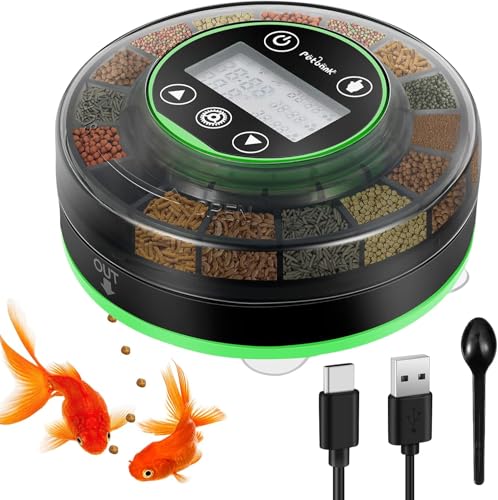
Petbank Automatic Fish Feeder
What We Like
- 16-grid portion control for accuracy
- Moisture-resistant sealed design
- USB-C rechargeable battery lasts 1-2 months
- Two mounting options: clamp or suction cup
Trade-offs
- Not compatible with flakes or shrimp
- Only 3 feedings per day maximum
- Outlet compartment should not store food
The 16-grid design, each holding up to 2 grams, lets you set precise portions for each meal instead of relying on a single compartment. That accuracy is useful when you’re away for a weekend or longer, because each serving stays separate and the opening closes automatically after feeding to keep moisture out. It works well with pellets, powders, or small strips, and the USB-C rechargeable battery (700mAh) charges in three hours and lasts one to two months, so you don’t need to hunt for disposables before a trip.
The Petbank feeder’s moisture-proof design keeps food dry because its opening seals after each feeding, unlike ordinary feeders with a single always-open compartment that can cause jams. It holds up to 2 grams per grid across 16 grids for 15 individual meals, so you can store different foods and control portions precisely. Compared to the Fish Mate F14, which uses a simpler rotating drum and batteries, the Petbank offers rechargeable USB-C power and more portion control, but the F14 is smaller and lighter if space is tight. Reviewers note that the feeder works with pellets, powders, and small strips, but it won’t handle flakes or shrimp, so check your fish’s diet before buying.
Fish Mate F14 Aquarium Fish Feeder

What We Like
- Up to 14 scheduled meals
- Gradual dispensing reduces overfeeding
- Runs over a year on one AA battery
- Fits hood, tray, or glass edge
Trade-offs
- AA battery not included
- No rechargeable or USB power option
- Compact size limits food capacity
The Fish Mate F14 delivers up to 14 individual portions across 1 to 4 meals per day, so you can cover a weekend away without worrying about overfeeding. The gradual dispensing over several hours helps reduce overfeeding and supports more consistent feeding patterns, which matters more than flashy app features when your goal is consistent feeding. This feeder runs over a year on a single AA battery, so it’s a straightforward, battery-powered option that doesn’t require smartphone pairing or firmware updates.
The trade-off is that it runs on a single AA battery (not included) and offers no rechargeable or USB-C option like the Petbank Automatic Fish Feeder does. That means you’ll need to keep a spare battery handy, but the feeder lasts over a year on one, so it’s not a frequent hassle. If you prefer a modern rechargeable unit with a digital display, the Petbank is a reasonable alternative, but the Fish Mate’s mechanical reliability and simple portion control are hard to beat for a classic, no-fuss design.
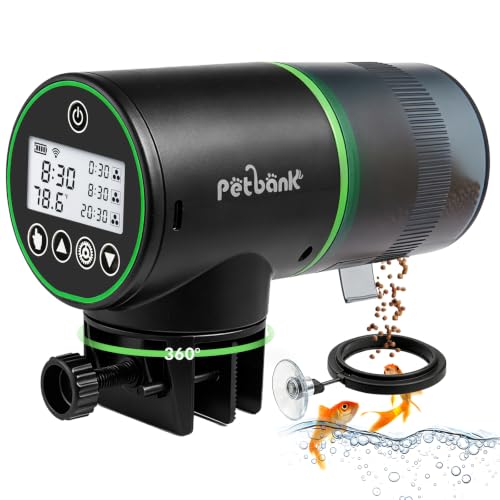
Petbank WiFi Automatic Fish Feeder
What We Like
- Smart app remote control with feeding logs
- Real-time water temperature monitoring and alerts
- Dual power supply with automatic battery backup
- Flexible mounting with 360° rotating base
Trade-offs
- App remote control disabled in battery mode
- Requires USB power for full smart features
A built-in temperature sensor that sends real-time alerts to your phone means this feeder does more than just drop food, it helps you catch temperature swings before they stress your fish. That dual power supply (USB plus automatic battery backup) keeps the schedule running during outages, though the app remote only works when plugged in. For anyone who travels or wants to monitor water conditions remotely, this is the most connected option in the guide.
A key limitation is that the smart features depend on USB power, so if you rely on the battery backup during a long outage, you lose remote control (preset schedules still run). Compared to the Hygger WiFi feeder, which includes a camera for visual checks, the Petbank focuses on temperature monitoring instead. That makes it a better fit for keepers who want environmental alerts over live video, but less ideal if you need to see your fish while away.
Product photos
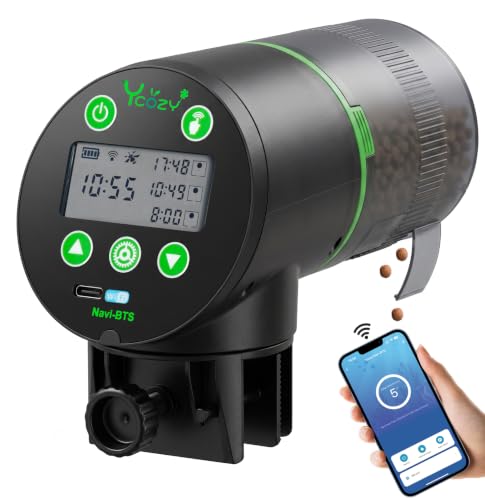
Ycozy WiFi Automatic Fish Feeder
What We Like
- USB-C plug-and-play power
- WiFi remote control via app
- 15-level food amount adjustment
- Two installation methods included
Trade-offs
- Requires constant USB-C power connection
- Only works on 2.4GHz WiFi networks
- Not compatible with fast chargers over 5V
The USB-C power input is the single most practical feature here for anyone tired of hunting for proprietary chargers or replacing batteries mid-vacation. Plug it into any standard 5V USB port, phone charger, laptop, power bank, and the Ycozy stays running as long as there’s juice. That makes it a genuinely set-and-forget option for trips up to two weeks, with the 200ml hopper and 15-level food outlet giving you fine control over portion size. The WiFi app adds remote scheduling and feeding history logs, so you can check in from anywhere and adjust if needed. It suits owners who want a modern, always-on feeder without battery anxiety, especially if you already have USB ports scattered around the house.
A key limitation is that this feeder must stay plugged in at all times, no battery backup means a power outage stops feeding until the router and feeder come back online (the app does notify you and auto-reconnects). Compared to the Petbank Automatic Fish Feeder, which runs on rechargeable batteries and doesn’t depend on a wall outlet, the Ycozy is less forgiving if your tank is far from a power source or you lose electricity frequently. It also requires a 2.4GHz WiFi band, so if your home network runs only 5GHz, you’ll need to enable dual-band on your router. For most users with a nearby outlet and a compatible router, the convenience of USB-C power and app control outweighs these limits.
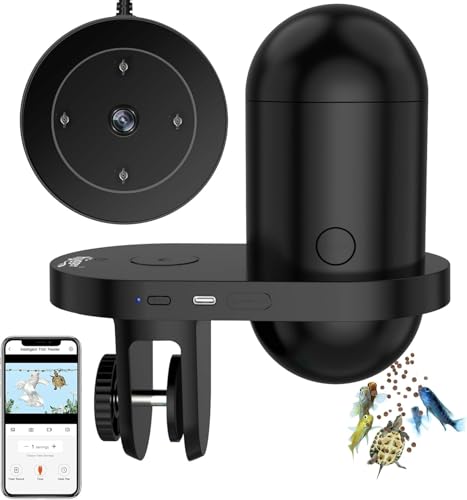
Hygger WiFi Automatic Fish Feeder
What We Like
- 2K HD camera for live monitoring
- Customizable feeding schedule via app
- Moisture-proof auto-closing lid
- Two food outlets for different fish sizes
Trade-offs
- Not suitable for shrimp or flake food
- Requires app and WiFi to program
A built-in 2K HD camera is the standout feature here, letting you check on your fish and see exactly how much food lands in the tank through the app. That real-time view is a practical upgrade over the usual timer-only feeders, especially if you’re away for days and want to confirm everything’s running right. The 230ml capacity handles a decent stretch of vacation feeding, and the two interchangeable food outlets let you dial in portion size for small or large fish without guesswork.
A notable drawback is that this feeder depends entirely on WiFi and the app for setup and scheduling, so if your tank is in a spot with spotty signal or you prefer a simple push-button timer, it adds complexity. The Petbank WiFi feeder offers temperature monitoring but lacks a camera, so you’re trading a live view for that extra sensor. For anyone who wants visual confirmation their fish are being fed properly while they’re away, the camera makes the Hygger worth the extra app fuss.
Product photos
Aoyar Automatic Fish Feeder
What We Like
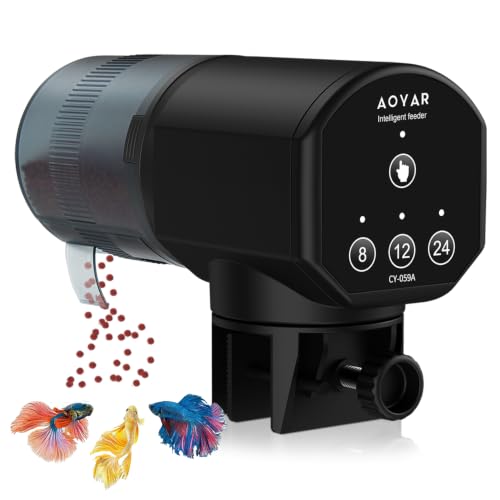
- 200ml large capacity for extended vacations
- Moisture-proof lid reduces clumping
- Three fixed feeding modes simplify setup
- Works with flakes, granules, powder, strips
Trade-offs
- No rechargeable battery or USB power option
- Fixed intervals limit custom timing flexibility
- No WiFi or app control for remote adjustment
A notable drawback is that you give up the convenience of rechargeable power or app-based scheduling. Unlike the Petbank WiFi model, this Aoyar runs on batteries and sticks to those three preset intervals, so you cannot fine-tune feeding times remotely or check on your tank from your phone. If your schedule is unpredictable or you travel often, the lack of WiFi might feel limiting. But for straightforward, large-capacity feeding at a budget-friendly price point, this feeder delivers exactly what it promises without extra complexity.
Product photos
Freesea Automatic Fish Feeder
What We Like
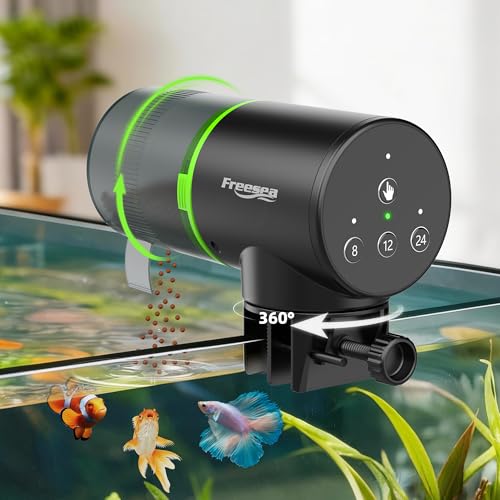
- 3 programmable timers for flexibility
- Moisture-proof lid blocks 90% humidity
- 200ML capacity for 7-14 day supply
Trade-offs
- No rechargeable battery, requires batteries
- Only 3 timers, fewer than some competitors
A seven- to fourteen-day food supply covers a typical vacation without needing a refill, so you can leave town with peace of mind. The moisture-proof lid blocks ninety percent of humidity, which keeps pellets from clumping in a damp tank room. This feeder suits anyone who wants to set it and forget it, especially first-time users or those who dread programming gadgets.
A key limitation is that three timers are fewer than the six you get on something like the Petbank WiFi feeder, so if you need multiple feedings spread across the day for a heavily stocked tank, you might hit a limit. That said, the Freesea’s simplicity is its strength: no app to pair, just set it and go. The ABS salt-fog resistant build holds up in the humid environment near a tank, and the sliding cover gives precise portion control to avoid overfeeding. It’s a straightforward, no-fuss tool for the vacation feeder buyer who values speed over features.
Product photos
FISHNOSH Automatic Fish Feeder

What We Like
- Fits small tanks and ponds
- Up to 9 feedings per day
- Easy refill without removal
- Simple enough for kids to operate
Trade-offs
- Requires battery replacement (not rechargeable)
- Up to 3 feedings per round, not per day
At just 0.4 pounds and 6.1 inches long, this feeder mounts easily on small tanks without tipping them, yet its adjustable portions and up to nine daily feedings also handle large aquariums and ponds. That range makes it a practical choice for anyone with multiple tanks of different sizes, or for a single setup that might change over time. The straightforward programming and tool-free refill mean you can set it and forget it, even if you’re not particularly handy.
A notable drawback is that this feeder lacks the USB-C rechargeable battery found on the Petbank Automatic Fish Feeder, so you will need to replace batteries more often. For most users juggling a few tanks, though, the flexibility and ease of use outweigh that limitation.
Product photos
AquaMiracle Automatic Fish Feeder

What We Like
- 200ml moisture-proof drum for vacations
- Accepts granules, pellets, strips, flakes
- 360° rotatable bracket fits rimless, framed, or hooded aquariums
Trade-offs
- No LCD screen for precise settings
- Flakes must be broken into small pieces
- Only three timer intervals, no custom schedule
It handles granules, pellets, strips, and flakes (just break the flakes up first), making it a straightforward option for mixed-diet tanks or turtle setups where orientation flexibility matters more than a digital display.
Simplicity is the main trade-off: you get only three fixed feeding intervals, and there’s no screen to confirm your selection, just a button press. The moisture-proof design helps keep dry foods fresh, though flakes need manual breaking for consistent volume control. If you value fuss-free mounting and don’t need app control or minute-by-minute timing, this is a reliable, no-nonsense pick.
Product photos
Fishkeeper Automatic Fish Feeder

What We Like
- 16 sealed grids for precise portions
- 800mAh battery lasts 100 days
- Moisture-proof sealed lid
- Power failure memory retains schedule
Trade-offs
- Not suitable for shrimp or flakes
- Only one timer mode active at a time
- Outlet compartment must stay empty
Sixteen sealed compartments, each holding up to 2 grams, let you pre-portion different foods without mixing or moisture issues. The 800mAh rechargeable battery runs up to 100 days, and if the power cuts, the feeder remembers your schedule as long as the battery still has charge. That means you can set precise portions and feeding times and trust it to keep working reliably.
A key limitation is that this feeder only works with powders and granules between 0.1 and 4mm, flakes and shrimp are out, so check your fish’s food type first. You also have to choose between two timer modes: the preset nine-time schedule or a custom mode with up to six feedings per day, not both at once. Compared to the Fish Mate F14, which is simpler and lighter, the Fishkeeper requires more setup but gives you much finer control over each meal. For anyone who wants exact portions and timing, this feeder delivers.
Product photos
How We Evaluated Automatic Fish Feeders
Our research began with a close look at each feeder’s technical specifications, motor type, battery life claims, food hopper capacity, and programmable timer options. We cross-referenced these specs with manufacturer documentation to verify operating limits, such as maximum daily feedings and compatible food particle sizes.
We organized the evaluation around four criteria that matter most for automatic fish feeders: feeding accuracy and portion control, power reliability (battery life versus USB or AC power), food compatibility (pellets, granules, flakes, or powders), and mounting versatility for different tank rims, hoods, and pond edges. Owner feedback patterns helped us spot real-world issues like moisture clumping, timer drift, and motor jams that specs alone don’t reveal.
An evaluation based on documented specifications, expert round-ups, and the collective experience of aquarium owners can identify reliable designs and common failure points. But it cannot replace long-term durability or food dispensing consistency testing across every brand of pellet.
What To Look For In Automatic Fish Feeders
The right automatic fish feeder keeps your fish fed on schedule while protecting water quality. Focus on portion control, power source, and food compatibility before considering smart features.
Choose a feeder that matches your food type, fits your tank rim, and runs long enough to cover your longest absence without jamming or clumping.
Portion Control and Feeding Accuracy
The most common mistake with automatic feeders is overfeeding, which spikes ammonia and fouls the water. Look for a feeder that dispenses food in measured portions rather than a continuous trickle. The Petbank and Fishkeeper models use sealed 16-grid drums that release one compartment per feeding, giving you precise control over how much food drops each time. Others use rotating augers or dial-based portion settings that let you adjust from a few pellets to a larger serving.
If you feed a mix of pellet sizes or powdered supplements, check whether the dispensing mechanism can handle them without jamming. Most feeders work best with uniform pellets or granules, while flakes and shrimp-based foods often require a different rotor design.
Power Source and Battery Life
Your feeder’s power source determines how reliably it runs and where you can place it. Battery-operated models like the Fish Mate F14 can run over a year on a single AA battery, making them ideal for tanks without nearby outlets. Rechargeable USB-C models, such as the Petbank, offer 1-2 months of runtime and eliminate battery waste. WiFi-enabled feeders typically require constant USB or AC power to keep their app and sensors active, with battery backup for short outages.
Consider how often you’re willing to change or recharge batteries. A feeder that dies mid-vacation defeats the purpose. Some owners prefer the simplicity of a pros and cons evaluation to weigh battery convenience against the reliability of a plugged-in unit.
Food Compatibility and Moisture Protection
Not all feeders handle every food type. Many top-rated models explicitly state they are not suitable for flakes or shrimp-based foods because those particles can clog the rotor or degrade inside the hopper. If you feed flakes, look for models like the AquaMiracle or Aoyar that accept them, or check our guide to feeders for flakes for specific recommendations.
Moisture protection is critical, humidity from the aquarium can cause food to clump inside the hopper, jamming the mechanism. Sealed lids, desiccant compartments, and moisture-proof drums help keep food dry. The best designs, like the Petbank’s sealed grids, isolate each portion until it drops, so the main food supply stays dry between feedings.
- Measure your tank rim or hood thickness before buying, some clamps only fit glass up to 12mm thick
- Check the maximum daily feedings: 3 per day is common, but some models offer 9 or 14
- For pond setups, look for larger hoppers and weather-resistant construction; see our roundup of pond feeders for outdoor-rated options
- Confirm the feeder accepts your food particle size, some models require flakes to be broken into small pieces
A feeder that matches your food type and tank setup will outperform a feature-packed model that fights your daily routine.
Automatic Fish Feeders Compared
The table below compares all 10 automatic fish feeders across the key specs that matter for portion control, power, food compatibility, and mounting.
| Product | Capacity | Feedings per day | Dimensions |
|---|---|---|---|
| Petbank Automatic Fish Feeder | 16 grids, 2g each | Up to 3 | 5.5 x 5.0 x 3.3 inches |
| Fish Mate F14 Aquarium Fish Feeder | 14 portions | 1 to 4 | 4.6 x 5.5 x 1.5 inches |
| Petbank WiFi Automatic Fish Feeder | N/A | 6 timers | 6.0 x 2.8 x 3.0 inches |
| Ycozy WiFi Automatic Fish Feeder | 200ml | N/A | 6.5 x 4.7 x 3.5 inches |
| Hygger WiFi Automatic Fish Feeder | 230ml | N/A | 7.0 x 4.0 x 8.0 inches |
| Aoyar Automatic Fish Feeder | 200ml | 3 fixed intervals | 5.9 x 2.8 x 4.7 inches |
| Freesea Automatic Fish Feeder | 200ML | 3 programmable | 5.8 x 2.8 x 4.4 inches |
| FISHNOSH Automatic Fish Feeder | N/A | Up to 9 | 6.1 x 2.8 x 4.4 inches |
| AquaMiracle Automatic Fish Feeder | 200 ml | 3 options | 5.8 x 2.7 x 4.1 inches |
| Fishkeeper Automatic Fish Feeder | 16 sealed grids, 2g each | Up to 6 | 6.3 x 4.3 x 3.1 inches |
Frequently Asked Questions
How many times a day should an automatic fish feeder feed?
Most automatic feeders allow 1 to 3 feedings per day, which suits the majority of tropical fish. Some models, like the Fish Mate F14, offer up to 14 scheduled meals for fish that need smaller, more frequent feedings. Check your fish species’ dietary needs and match the feeder’s maximum timer intervals accordingly.
Can automatic fish feeders handle flake food?
Some automatic feeders work with flakes, but many do not. The Aoyar and AquaMiracle models accept flakes, while the Petbank and Fishkeeper feeders are designed for pellets and powders only. Flakes are more prone to clumping and jamming, so look for a feeder with a moisture-proof lid and a rotor that can handle thin, flat pieces.
What happens if the feeder runs out of food while I’m away?
If the hopper empties mid-vacation, the feeder will continue rotating but dispense nothing. Choose a feeder with a capacity that covers your longest absence, 200ml models like the Aoyar or Freesea can hold a 7-14 day supply depending on portion size. For extended trips, consider a larger hopper or a model with a transparent window so you can verify the food level before leaving.
Do WiFi fish feeders work without internet?
Most WiFi feeders require an active internet connection for remote app control and feeding logs. The Petbank WiFi model disables app control when running on battery backup, and the Hygger needs WiFi and its app to program schedules. If you need a feeder that works entirely offline, choose a mechanical timer model like the Fish Mate F14 or Aoyar.
How do I clean an automatic fish feeder?
Remove the hopper and rinse it with warm water, avoiding soap residue that could harm fish. Wipe the rotor and dispensing opening with a damp cloth. Let all parts dry completely before refilling with food. Some feeders, like the Petbank, have sealed compartments that reduce the need for frequent cleaning, but any feeder that handles moist food should be checked monthly for clogs.
The Bottom Line
The Petbank Automatic Fish Feeder earns the best overall spot because its 16-grid portion control, moisture-resistant design, and USB-C rechargeable battery cover the essentials most fish keepers need. It works best with pellets and powders, so if you feed flakes, the Aoyar or AquaMiracle are better choices for their broader food compatibility.
Budget-minded owners or those who want a set-and-forget solution should look at the Fish Mate F14 for its year-long battery life and mechanical reliability. For remote monitoring and control, the Petbank WiFi model adds water temperature alerts and feeding logs, while the Hygger with its 2K camera lets you actually see your fish eat from anywhere.
The single most important buying factor is food compatibility, match the feeder’s dispensing mechanism to what you feed, and everything else falls into place.
